Dropshipping vs. Print on Demand: Which One Should You Actually Start?
A guy I know — an old college roommate, actually — tried dropshipping phone accessories back in 2021. He picked a trending product, ran some ads, made a bit of money for about six weeks, and then watched his margins evaporate as five other stores discovered the exact same “winning product” and started undercutting him on price. He shut it down, frustrated, and swore off e-commerce entirely. Two years later, almost by accident, he started selling hoodies with his own hand-drawn illustrations through a print-on-demand store. Same general category of business — sell products online without holding inventory — but a completely different experience. No one else was selling his exact designs, so there was no race to the bottom on price. That store is still running today.
His story is basically a live demonstration of the real difference between these two business models, and it’s why so many beginners end up asking the same question: dropshipping or print on demand — which one’s actually better?
Here’s the honest answer: it depends entirely on what kind of entrepreneur you actually are, not on which model is objectively superior. Both let you sell products online without ever touching inventory, which makes them genuinely attractive entry points into e-commerce. But they diverge in some pretty important ways once you look closely — ways that affect your competition, your branding, your creative workload, and ultimately your profit margins.
Let’s break both models down properly so you can figure out which one actually fits you.
What Dropshipping Actually Is
Dropshipping is an e-commerce model where you sell products online without ever storing inventory yourself. Instead of buying stock upfront, you partner with suppliers who ship products directly to your customers the moment an order comes in. You’re essentially the middleman connecting a customer with a supplier’s catalog, minus the customer ever knowing that’s what’s happening.
Here’s how it actually plays out, step by step:
You build your online store and list products you’ve sourced from a supplier. A customer visits your store and places an order. You forward that order straight to your supplier. The supplier then packages the product and ships it directly to your customer’s door.
Because you never touch, store, or ship the product yourself, dropshipping lets you launch a real business with genuinely minimal upfront investment — no warehouse, no bulk inventory purchase, no shipping logistics to figure out on your own.
What Print on Demand Actually Is
Print on demand — usually just called POD — is a more specialized cousin of dropshipping, where the products being sold feature custom designs that get printed only after a customer actually places an order. Instead of selling generic, off-the-shelf items, you’re selling things that carry your own creative work.
Common POD products include: t-shirts, hoodies, mugs, phone cases, posters, tote bags, and stickers.
Unlike traditional dropshipping, where you’re mostly picking existing products to resell, POD businesses live and die by custom design and branding — the product itself becomes an extension of your creative identity, not just a functional item.
How the POD process typically works:
You create original designs. You upload those designs to a print-on-demand platform. Customers browse and purchase products featuring your work. The POD company then prints your design onto the chosen product and ships it directly to the buyer.
This lets you sell genuinely personalized products without ever needing to buy or manage inventory — the printing itself only happens once a real order exists.
The Real Differences Between the Two
Technically, print on demand is a specific flavor of dropshipping. But in practice, the two models diverge in some meaningful ways.
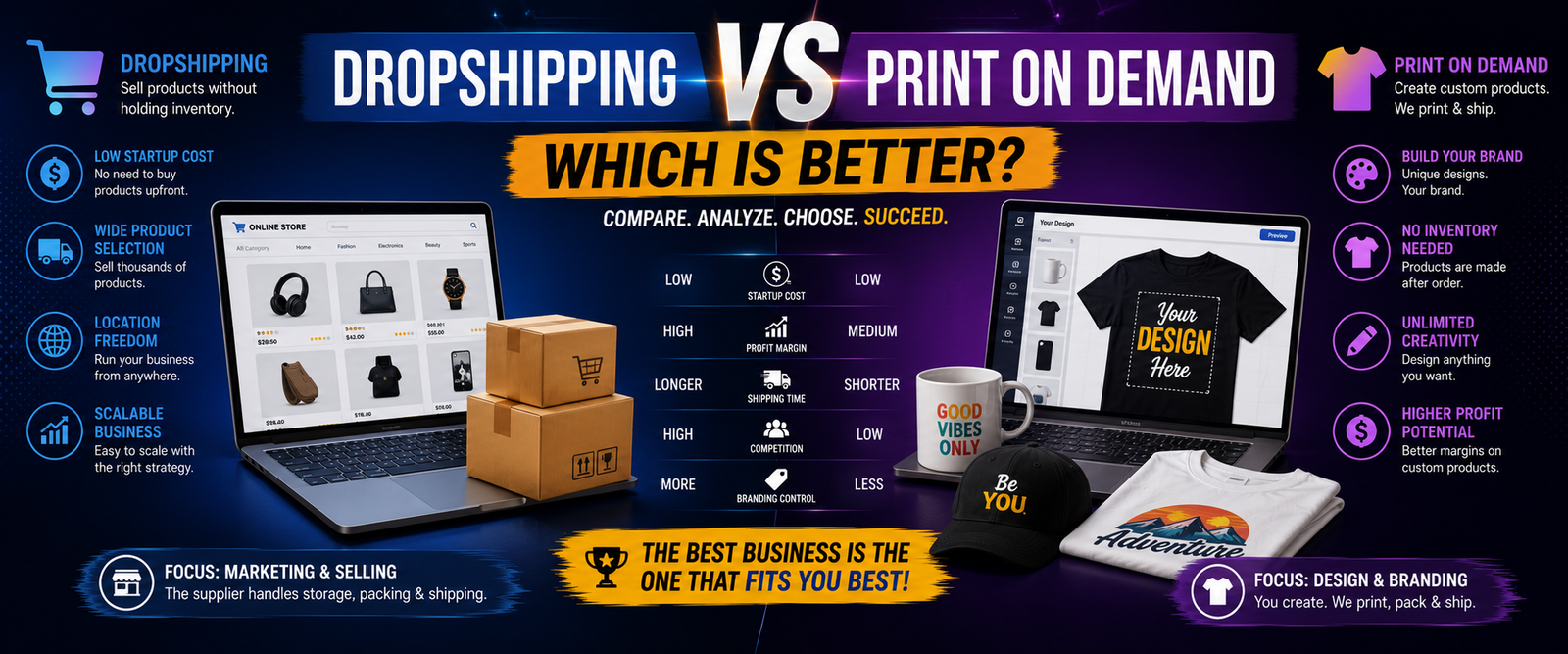
Product types differ significantly. Dropshipping stores tend to sell generic products sourced from a supplier’s existing catalog. POD stores sell products built specifically around your own custom designs.
Branding potential is night and day. Because your artwork literally appears on the product itself, POD naturally supports much stronger branding. Dropshipping, by contrast, often means selling the exact same item that dozens of other stores are also selling — which makes standing out considerably harder.
Creativity plays a very different role. POD businesses rely heavily on genuine design skill and creative direction. Dropshipping leans more on product selection instincts and marketing execution rather than artistic ability.
Competition looks different too. Dropshipping markets can get brutally competitive precisely because so many stores are selling identical products. POD stores, when the designs are genuinely original, tend to face meaningfully less direct competition — nobody else can sell your specific illustration.
The Case for Dropshipping
Dropshipping has become hugely popular, and it’s not hard to see why once you look at the actual advantages.
Startup costs stay low. You’re not buying inventory upfront, which dramatically reduces your financial risk if things don’t work out.
Your product catalog can be massive. Dropshipping stores can realistically sell thousands of different products spanning categories like electronics, home decor, beauty products, kitchen gadgets, and fitness equipment — there’s essentially no ceiling on variety.
Scaling is genuinely easier. Since your suppliers are handling production and shipping, your energy stays focused on marketing and customer acquisition rather than operational logistics.
There’s no inventory to manage. No warehouse, no storage costs, no unsold stock sitting around depreciating in value.
It’s about as flexible as a business gets. You can run a dropshipping operation from anywhere with a laptop and an internet connection.
Where Dropshipping Falls Short
It wouldn’t be a fair comparison without the real downsides.
Competition is often brutal. Because a huge number of entrepreneurs are sourcing from the exact same supplier catalogs, standing out from an identical product lineup is genuinely difficult — this is exactly what happened to my old roommate.
Profit margins tend to shrink under pressure. When your product is widely available across many stores, price competition kicks in fast and eats into your margins.
Quality control is largely out of your hands. You’re trusting your supplier to maintain consistent product quality, and if they slip, your store’s reputation takes the hit regardless of whose fault it actually was.
Shipping delays are a real risk. Products sourced from overseas suppliers can take a while to arrive, which creates real friction with customer expectations, especially in markets used to fast delivery.
Building a real brand is genuinely harder. When you’re selling largely generic products, it’s tough to create the kind of recognizable identity that keeps customers coming back specifically to you rather than whichever store happens to have the lowest price that week.
The Case for Print on Demand
POD offers a distinctly different set of advantages, most of them tied to the creative ownership baked into the model.
Your products are genuinely unique. Your own designs differentiate your store in a way generic dropshipping simply can’t replicate.
Branding comes naturally. Custom designs give you a real foundation to build a recognizable, memorable brand around.
There’s real room for creative expression. If you’re an artist or designer, POD lets that creativity become the actual product, not just the marketing around it.
Competition tends to be lower. Unique designs mean you’re not going head-to-head with dozens of identical listings the way dropshipping stores often are.
No inventory required here either. Just like dropshipping, POD businesses skip the warehouse and bulk stock entirely.
Where Print on Demand Falls Short
POD isn’t without its own real limitations.
Product variety is more limited. Most POD platforms center around apparel and accessories, so if you’re hoping to sell a wide range of unrelated product categories, this model constrains you more than dropshipping does.
Production costs run higher. Custom printing adds real cost per unit compared to sourcing a pre-made generic item, which narrows your margins unless pricing is handled carefully.
You genuinely need design skill. A successful POD store usually depends on strong creative concepts — if design isn’t your strength, this becomes a real bottleneck.
Fulfillment tends to be slower. Since products are printed only after an order comes in, delivery timelines can run longer than dropshipping items that were already sitting ready to ship.
Margins can shrink if you’re not careful. Higher production costs mean your pricing strategy has to work harder to protect a healthy profit margin.
Comparing the Actual Startup Costs
Both models can genuinely be started on a modest budget, and the expense categories look fairly similar.
Dropshipping costs generally include website hosting, an e-commerce platform subscription, and whatever advertising budget you allocate to actually driving traffic.
Print-on-demand costs typically include a website platform, design tools (which can range from free to a modest monthly fee), and marketing expenses.
In most cases, either model can realistically be launched for under a few hundred dollars total, depending on which specific tools and platforms you choose along the way.
Comparing the Actual Profit Potential
Profitability in either model comes down heavily to product pricing, marketing execution, and how well you’ve chosen your niche.
Dropshipping’s profit potential tends to scale quickly if you land on a genuinely winning product early — but that same product’s popularity often attracts competitors fast, which can compress margins over time.
Print on demand’s profit potential leans more on brand loyalty and design strength. A distinctive, well-loved brand can support higher pricing and a more loyal repeat-customer base than a typical dropshipping store selling generic items.
Marketing Matters Either Way
Regardless of which model you pick, marketing execution is what actually determines whether the business succeeds.
Social media marketing through platforms like Instagram and TikTok is genuinely effective for showcasing products visually — this matters especially for POD, where the design itself is the selling point.
Influencer marketing can extend your reach considerably by putting your products in front of an audience that already trusts the person promoting them.
Content marketing — blog posts, videos, tutorials related to your niche — pulls in organic traffic over time without an ongoing ad spend.
Paid advertising remains one of the fastest ways to drive traffic directly to your store, though it comes with an ongoing cost that needs to be factored into your margins.
Neither model succeeds on product alone — the marketing layer underneath is where most of the real business actually happens.
So Which One’s Actually Better for a Beginner?
Both models are genuinely beginner-friendly, but the right choice depends heavily on your own personality and strengths.
Dropshipping might suit you better if you: enjoy the process of researching and testing many different products, get energized by marketing and customer acquisition strategy, and want access to a large, varied product catalog rather than a narrow niche.
Print on demand might suit you better if you: genuinely enjoy design and creative work, want to build something that feels like a real brand rather than a generic storefront, and would rather sell fewer, more distinctive products than a huge catalog of common ones.
Worth noting: plenty of entrepreneurs don’t actually pick one exclusively — some combine both models within a single store, using dropshipped products to round out a catalog built primarily around their own POD designs.
Thinking About the Long Game
Both dropshipping and print on demand can absolutely grow into genuinely successful, lasting businesses. But branding tends to be the factor that separates the stores that fade after a year from the ones that build something durable.
Businesses that manage to build real brand identity — regardless of which model they started with — tend to see stronger customer loyalty, healthier profit margins, and more repeat purchases than stores competing purely on price. This is a big part of why a lot of experienced e-commerce entrepreneurs push newcomers to focus on building a brand from day one, rather than just chasing whatever product happens to be trending that month.
Where E-Commerce Seems to Be Heading
The broader e-commerce landscape keeps shifting, and a few trends are worth keeping an eye on regardless of which model you choose.
AI-powered product research is helping entrepreneurs spot trending products faster and with more precision than manual research alone ever could.
Personalized products continue gaining ground, with more customers actively preferring items tailored specifically to them rather than generic mass-market goods.
Sustainable products are becoming a bigger factor in purchasing decisions, as more consumers actively weigh environmental impact when they shop.
Social commerce — buying directly through social media platforms rather than an external website — keeps growing quickly, and it’s reshaping where the actual point of sale happens.
Entrepreneurs who stay alert to these shifts and adapt their approach accordingly tend to build considerably stronger, more resilient online businesses over time.
Final Thoughts
Dropshipping and print on demand remain two of the most genuinely accessible ways to launch an online business today, and both let you skip the traditional headaches of inventory management that used to be a real barrier to entry for new entrepreneurs.
Dropshipping offers flexibility, a broad product catalog, and real scalability once you find something that sells. Print on demand leans into creativity, stronger branding potential, and genuinely unique products that stand apart from the crowd.
The right choice ultimately comes down to your own skills, interests, and what you actually want your business to feel like day-to-day. If product research and marketing genuinely excite you, dropshipping is likely the better starting point. If you’d rather build something creative and distinctly yours, print on demand is probably the path worth exploring first.
Whichever direction you go, success will come down to the same fundamentals either way: real dedication, genuine creativity, and a solid understanding of who your customer actually is. With the right approach, both paths can turn into legitimately profitable businesses in a space that’s still very much growing.