AI vs. Humans: Which Jobs Will Actually Disappear by 2030?
A friend of mine works in bookkeeping, and last year she told me something that stuck with me: “I used to spend my whole morning entering invoices. Now the software does it in about four minutes, and I just check its work.” She wasn’t panicked about it — if anything, she seemed relieved. But she also admitted she’s been quietly wondering how many more mornings like that she has left before her role looks completely different, or disappears altogether.
That conversation captures the real texture of what’s happening across the job market right now. It’s not some dramatic overnight robot takeover — it’s a slow, steady creep of automation into task after task, until entire jobs quietly restructure around whatever’s left for humans to do. And a lot of people, understandably, want a straight answer to one question:
Will AI actually replace human jobs by 2030?
The honest answer is that it’s complicated, and it cuts in multiple directions at once. Some jobs are genuinely on their way out. Others will survive but look different. And a surprising number of brand-new careers are going to exist by the end of this decade that don’t really exist yet today. The World Economic Forum has estimated that somewhere around 92 million jobs could become obsolete by 2030 due to automation and broader technological shifts. That’s a big number, and it’s worth sitting with. But it’s only half the picture — the same body of research also points to AI generating millions of new roles, with some estimates suggesting AI alone could create as many as 4 million new jobs in India by the end of the decade.
So let’s actually dig into this properly: what’s disappearing, what’s surviving, what’s brand new, and — probably the most useful part — what you can actually do about it.
How AI Actually Got This Capable
It’s worth pausing on just how far AI tools have come in a relatively short window. Machine learning and large language models can now write full articles, chew through massive datasets in seconds, answer customer questions convincingly, translate between languages fluently, and generate images and video from a simple text prompt. None of that was remotely mainstream a decade ago.
For businesses, this capability is genuinely attractive, and not for complicated reasons — it comes down to cost and consistency. AI reduces operational expenses, works around the clock without needing breaks, handles enormous volumes of data without breaking a sweat, and generally improves efficiency across the board. Put those together, and it’s not hard to see why companies are leaning into it as fast as they are. The natural consequence is that a lot of traditional jobs are becoming less necessary — particularly ones built around routine, repetitive, predictable work.
Why Some Jobs Are More Vulnerable Than Others
Here’s the thing people often miss: AI isn’t replacing jobs randomly. It tends to go after roles that share a specific set of characteristics.
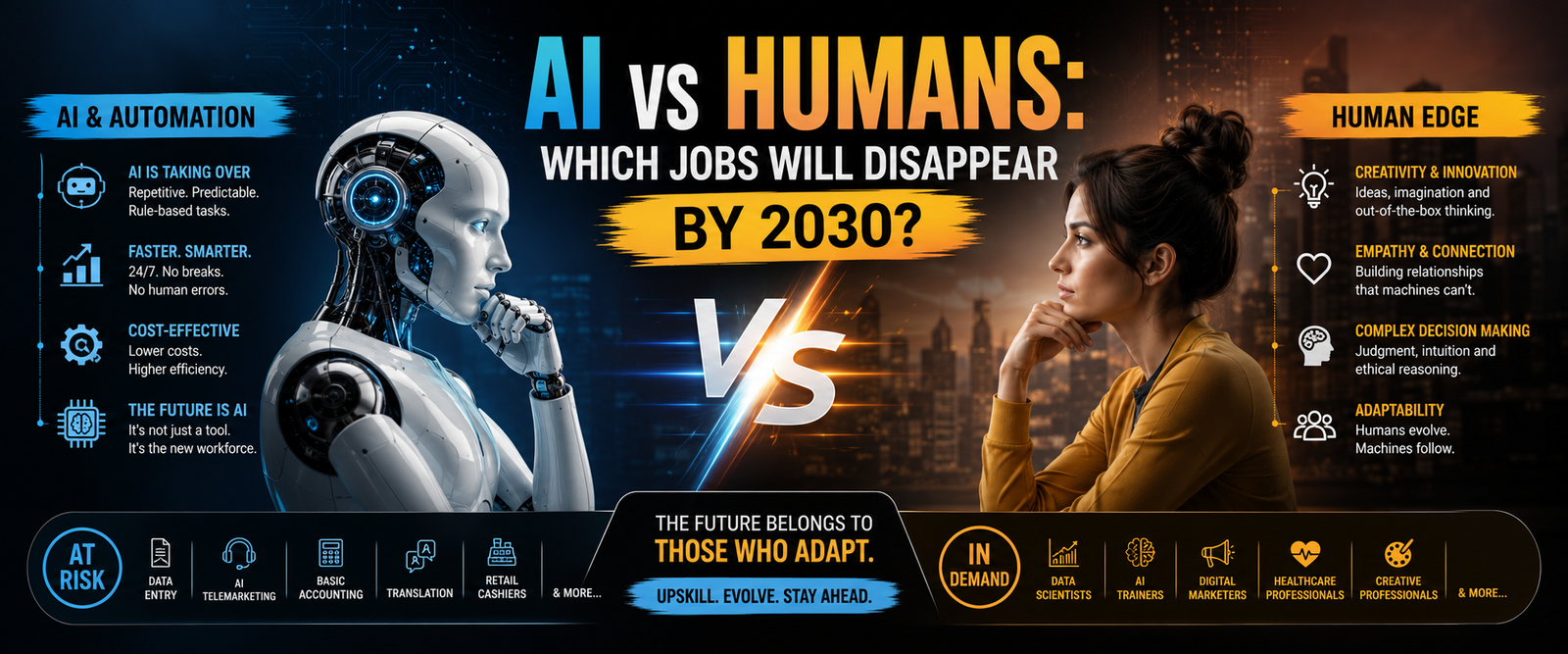
Repetitive tasks are the most obvious target — anything following the same pattern day after day is a prime candidate for automation. Think data entry, telemarketing scripts, or basic accounting.
Rule-based work is next. If a job follows a clear set of instructions or a defined formula, AI can often execute it faster and more consistently than a human can. Loan processing, scheduling, and inventory management all fall into this bucket.
Purely digital tasks are easier to automate than physical ones, simply because there’s no robotics or manual dexterity required — document review, basic coding, and customer support conversations conducted entirely through text are good examples.
Low human-interaction roles round out the list. Jobs that don’t require much creativity or emotional nuance are inherently easier for a machine to step into, because there’s less of the “human element” that AI genuinely struggles to replicate.
With that framework in mind, let’s look at the specific roles most likely to shrink or disappear over the next several years.
The Jobs Most Likely to Disappear by 2030
1. Data Entry Clerks
This is widely considered the single most vulnerable role out there. AI software can now automatically extract data straight from documents, organize it into spreadsheets, update databases in real time, and process forms without a human ever touching a keyboard. Some estimates put the automation risk for data entry roles as high as 95% — which is about as close to “already gone” as a job description gets. Companies increasingly see little reason to hire someone to manually type information into a system when software can do it faster and without errors.
2. Telemarketers
AI voice systems have gotten disturbingly good at making calls, responding to questions in real time, and even personalizing sales conversations based on who’s on the other end of the line. Because these systems run continuously without needing a salary or commission, plenty of companies now prefer them outright over human callers. Automation risk estimates for telemarketing sit above 90%, making it one of the fastest-declining job categories out there.
3. Customer Service Representatives
Anyone who’s chatted with a support bot recently knows how far these systems have come. Modern AI assistants can handle basic questions, process refunds, track orders, and troubleshoot common technical issues — often as the very first point of contact before a human ever gets involved. Reports consistently show that routine customer support work is among the most exposed roles to automation, since so much of it follows predictable, scriptable patterns.
4. Bank Tellers
Banking has been steadily shifting online for years, and mobile apps have made physical branch visits increasingly rare. AI systems can now approve loans, detect fraudulent activity, manage account details, and even offer basic financial advice. As fintech continues expanding, the traditional teller role keeps shrinking right along with it.
5. Cashiers and Retail Checkout Workers
Self-checkout kiosks and automated payment systems have already replaced a meaningful chunk of cashier roles in stores everywhere. These systems let customers scan their own items, pay digitally, and walk out without ever needing staff assistance. As this technology gets cheaper to deploy, expect retailers to keep trimming these positions further.
6. Travel Agents
Travel planning has moved almost entirely online. AI-powered platforms can compare thousands of flights in seconds, suggest full itineraries, book hotels automatically, and tailor recommendations to individual preferences — all things that used to require a human travel agent’s expertise. The traditional travel agency model has been quietly declining for years, and AI is accelerating that trend.
7. Basic Accounting and Bookkeeping
AI accounting tools can track expenses, generate invoices, calculate taxes, and produce financial reports without much human oversight. Accountants themselves aren’t going anywhere — the strategic, advisory side of the profession still needs a human — but the routine bookkeeping layer underneath it is expected to shrink considerably.
8. Warehouse Workers
Robotics and AI-driven logistics have transformed how warehouses operate. Robots now sort packages, move inventory around the floor, pack products, and help manage entire supply chains. This kind of automation is steadily reducing the need for human labor in the more repetitive corners of warehouse work.
9. Manufacturing Line Workers
Industrial robots have been a factory fixture for decades, but AI integration has pushed their capabilities further — they can now detect product defects, adjust production processes on the fly, and handle precision assembly work that used to require a skilled human hand. As factories lean further into automation, traditional assembly line roles will keep declining.
10. Basic Content Writers
AI writing tools can now churn out blog posts, marketing copy, product descriptions, and social captions with minimal input. Writers focused purely on formulaic, high-volume content are the most exposed here. Writers bringing genuine creativity, strategic thinking, or a distinct voice to their work are in a much safer position — but the purely mechanical writing tasks are increasingly a job for a machine.
The Jobs That Aren’t Going Anywhere
It’s not all decline, though — plenty of careers are built around exactly the things AI still struggles with.
Healthcare professionals — doctors, nurses, therapists — rely on human empathy, complex on-the-fly decision-making, and physical patient interaction that AI simply can’t replicate. AI is becoming a genuinely useful assistant in healthcare, helping with diagnostics and administrative overhead, but it’s nowhere close to replacing the human at the center of patient care.
Skilled trades like electricians, plumbers, and mechanics involve physical dexterity combined with problem-solving in messy, unpredictable real-world environments — exactly the kind of scenario that even advanced robotics still finds genuinely difficult.
Teachers and educators do something AI fundamentally can’t: build emotional connection, motivate a room full of different personalities, and support social development in ways that go far beyond delivering information. AI can absolutely support learning as a tool, but it can’t replace the human relationship at the core of good teaching.
Creative professionals — filmmakers, designers, writers, musicians — still hold one of humanity’s clearest advantages. AI can assist enormously with creative production, but it still fundamentally relies on human direction, taste, and intent to produce something that actually resonates.
Leadership and strategy roles involve navigating uncertainty and human relationships in ways that are extraordinarily hard to codify into an algorithm. Executives, managers, and entrepreneurs are making judgment calls that go well beyond pattern recognition — which keeps these roles firmly in human hands for the foreseeable future.
The Jobs AI Is Actually Creating
Here’s the part that tends to get lost in the doom-and-gloom headlines: AI isn’t just erasing jobs, it’s actively generating brand-new ones.
AI engineers design the underlying algorithms that power these systems. Machine learning specialists train and refine models using real-world data. AI ethics specialists are an increasingly important role focused on making sure these systems are deployed responsibly. Data scientists analyze the enormous datasets that guide business decisions in an AI-driven world. And AI product managers oversee how AI-powered products actually get built and shipped.
These aren’t niche, hypothetical roles — reports suggest the AI economy could generate millions of new jobs over the coming decade, many of which barely existed in any recognizable form even five years ago.
The Real Story: AI Working With Humans, Not Just Replacing Them
Most experts studying this space land on a similar conclusion: the future isn’t really “AI vs. humans” — it’s AI working alongside humans. Rather than eliminating entire professions outright, AI more often automates the repetitive layer of a job while freeing up humans to focus on the higher-level parts that actually require judgment, empathy, or creativity.
A few examples make this concrete: doctors increasingly use AI to assist with diagnosis, but the human remains in charge of the actual care decision. Writers use AI to speed up research, but the final voice and judgment are still theirs. Programmers use AI to generate boilerplate code, freeing them up to focus on architecture and problem-solving rather than typing out routine syntax. In each case, AI functions less like a replacement and more like a very capable assistant sitting alongside the human doing the work.
The Skills That Will Actually Matter
If you want to stay competitive as this shift plays out, the smart move is developing skills that AI genuinely struggles to replicate.
Critical thinking — the ability to actually analyze a messy, ambiguous problem rather than follow a script — remains hard to automate.
Creativity stays valuable precisely because AI, even at its most impressive, is still fundamentally remixing patterns rather than generating truly original thought.
Emotional intelligence — reading a room, understanding what someone actually needs versus what they’re saying — is an area where machines remain genuinely weak.
Technology literacy matters more than ever, not because you need to become an engineer, but because understanding how these tools work (and where their limits are) will increasingly separate people who use AI effectively from people who get replaced by it.
Lifelong learning rounds it out. The specific tools will keep changing, so the real skill is staying adaptable enough to keep learning new ones as they show up.
How to Actually Future-Proof Your Career
A few practical, doable steps if you want to get ahead of this rather than react to it later:
Learn the AI tools relevant to your field. Even a working familiarity with the tools reshaping your industry puts you ahead of colleagues who are ignoring the shift entirely.
Build hybrid skills. Pairing technical fluency with creativity or strategic thinking is a combination AI genuinely can’t replicate on its own.
Double down on human skills. Communication, leadership, negotiation — these become more valuable, not less, as the repetitive layer of work gets automated away.
Stay adaptable. The specific technology will keep shifting under your feet for the rest of your career. The people who thrive won’t be the ones who mastered one tool — they’ll be the ones comfortable learning the next one when it arrives.
Final Thoughts
AI is going to reshape the workforce substantially over the next several years, and there’s no point pretending otherwise. Jobs built around repetition and predictable rules — data entry, telemarketing, routine bookkeeping, basic content writing — are genuinely shrinking, and that trend isn’t reversing.
But history has a pretty consistent track record here: major technological shifts tend to create more opportunity than they destroy, even if the transition period feels uneven and occasionally unfair. By 2030, the job market will almost certainly look different — routine roles will keep declining, AI-adjacent careers will keep expanding, and the distinctly human skills of creativity and emotional intelligence will likely become more valuable than they’ve ever been.
The smartest response isn’t fear — it’s adaptation. The people and careers that come out ahead of this shift won’t be the ones competing against AI. They’ll be the ones who figured out how to work alongside it.