The Best High-Interest Savings Accounts in the U.S. (2026 Guide)
My sister kept about $12,000 sitting in the same savings account she’d opened as a teenager for nearly a decade, at a big traditional bank, earning something so close to nothing that when she finally checked, she realized she’d made less interest over ten years than she’d have made leaving that money in a shoebox and just not losing it to inflation. When she finally switched to a high-yield account, the difference wasn’t subtle — she went from earning something like $15 a year to earning close to $500 a year, on the exact same balance, doing absolutely nothing differently except picking a different bank.
That gap is the whole story of this article, and it’s a genuinely wild one once you actually see the numbers side by side. Saving money is one of the most important financial habits a person can build, but a huge number of people are quietly sabotaging their own progress simply by parking that money in the wrong kind of account. The national average savings rate across the US sits at around 0.39% APY — a number so low it barely counts as interest at all, more of a rounding error than a meaningful return.
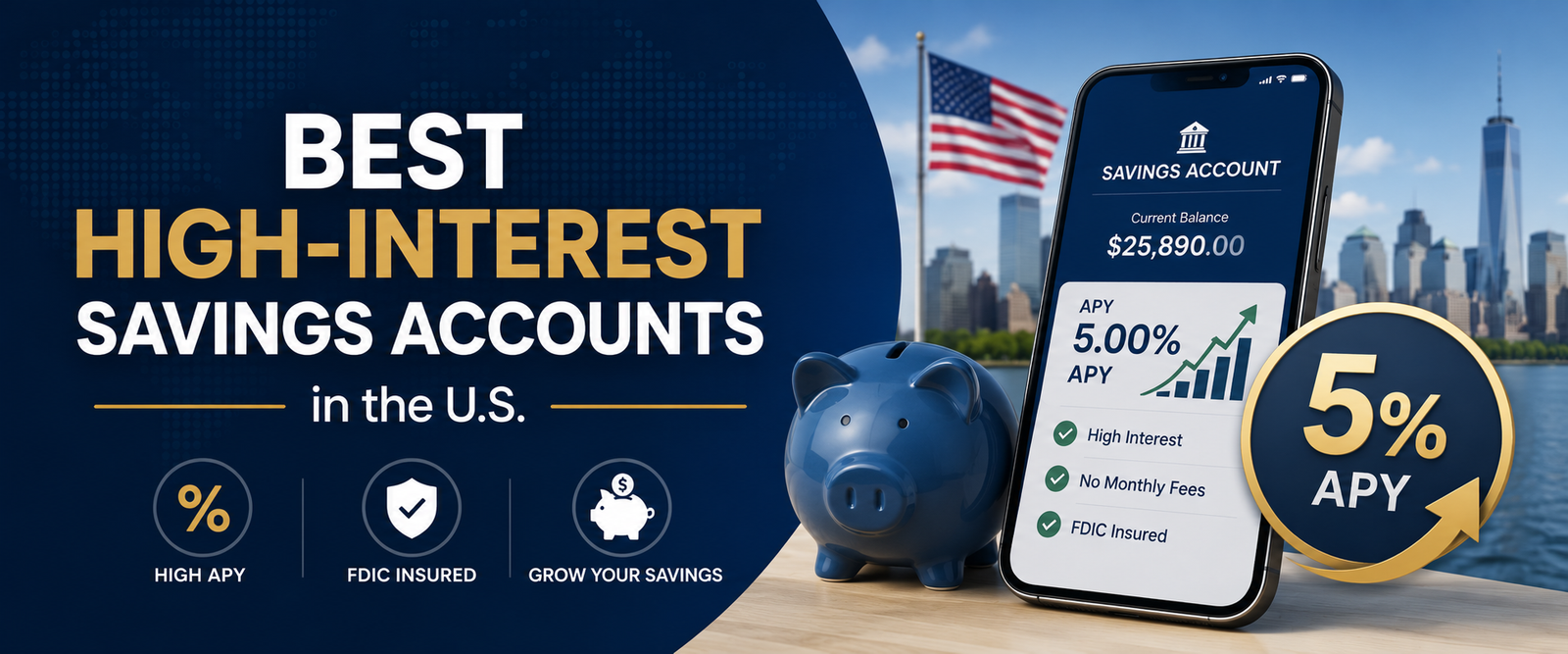
The good news is that high-interest savings accounts, often called high-yield savings accounts or HYSAs, offer dramatically better returns on the exact same deposited dollar. Some of the strongest accounts available in 2026 are paying somewhere around 4% APY or more — several times what a traditional bank offers, for essentially zero additional effort or risk on your part. This guide walks through what these accounts actually are, why they matter, which specific ones are worth your attention right now, and how to actually pick the right one for your situation.
What a High-Interest Savings Account Actually Is
A high-interest savings account is, at its core, exactly what it sounds like — a bank account that pays a meaningfully higher interest rate than a traditional savings account offers. These accounts are typically run by online banks or digital-first financial institutions, and the reason they can afford to pay you more comes down to their overhead. Without a network of physical branches to lease, staff, and maintain, these banks operate with dramatically lower costs, and a meaningful chunk of those savings gets passed along to customers in the form of a better rate.
Functionally, a high-yield account works exactly like the traditional savings account you’re probably already familiar with — you deposit money, the bank pays you interest on your balance over time, and you can withdraw funds when you actually need them. The real difference sits entirely in the annual percentage yield, or APY. Where the best high-yield accounts in 2026 are offering somewhere around 4% or higher, traditional banks are frequently still paying well under 0.5% on the same kind of account.
Why This Actually Matters More Right Now Than It Used To
Keeping money in a traditional savings account often means quietly losing real value over time, once you factor in inflation eating away at your purchasing power faster than a 0.4% return can keep pace with. High-interest savings accounts help protect against that erosion by actually earning a return that has a real shot at keeping up.
A few concrete reasons this matters:
The interest rate difference is genuinely dramatic. High-yield accounts commonly pay several multiples of what a standard account offers. As a real example: deposit $10,000 in a traditional account paying 0.4% APY, and you’d earn roughly $40 over a year. Put that same $10,000 in a high-yield account paying 4% APY, and you’d earn closer to $400 — ten times more, from an identical deposit, with essentially the same level of effort involved in opening either account.
Your money remains genuinely protected. Most high-interest savings accounts in the US carry FDIC insurance covering up to $250,000 per depositor, per bank — meaning your money stays protected even in the unlikely event the bank itself runs into trouble.
Managing the account is genuinely easy. Most modern high-yield accounts come with mobile apps, straightforward online transfers, and built-in automatic savings tools, letting you manage everything from your phone without ever needing to visit a branch.
Fees tend to be minimal or nonexistent. A lot of these accounts charge no monthly maintenance fee at all and require little to no minimum balance to open or maintain, which means the return you see is genuinely closer to the return you actually keep.
The Best High-Interest Savings Accounts Worth Looking At in 2026
Here’s a rundown of some of the strongest options currently available, based on APY, fees, and overall usability. A quick, important note before diving in: interest rates on these accounts shift fairly regularly based on broader economic conditions, so treat the specific APY figures below as a general snapshot rather than a locked-in guarantee — always double-check the current rate directly on the bank’s site before opening an account.
1. Newtek Bank Personal High Yield Savings
APY: around 4.20% Minimum deposit: $100 Monthly fees: none
Newtek has earned a genuinely strong reputation as one of the better savings accounts available in 2026, largely thanks to its competitive rate combined with minimal fees. The account has actually seen real demand from new customers specifically because of how strong that rate looks compared to the broader market.
Key features: a meaningfully higher interest rate than most traditional banks, zero monthly maintenance fees, and genuinely easy online account management.
Best for: someone looking for a straightforward, no-frills high-yield account with genuinely strong returns and nothing complicated attached to it.
2. Varo High-Yield Savings Account
APY: up to around 5.00% (conditions apply) Minimum balance: $0 Monthly fees: none
Varo is a fully digital bank offering one of the highest potential APYs currently on the market. The catch worth understanding upfront: that top rate typically requires meeting specific conditions, usually direct deposit and some level of ongoing monthly transaction activity. Without meeting those requirements, the base rate on the account tends to be noticeably lower.
Key features: a genuinely high potential interest rate, no minimum balance requirement, and a fully digital banking experience from account opening onward.
Best for: people who are comfortable with mobile-first banking and can reliably meet the account activity requirements needed to unlock that top rate.
3. Vio Bank High-Yield Online Savings
APY: around 4.03% Minimum deposit: $100 Monthly fees: none
Vio Bank has built a reputation specifically around offering consistent, reliable high-yield rates rather than a flashy introductory number that drops off after a few months.
Key features: a genuinely competitive APY, no monthly fees, and a simple, uncomplicated account structure without a lot of fine print to navigate.
Best for: savers who want stable, predictable returns without needing to jump through hoops or meet ongoing activity requirements.
4. Bread Savings High-Yield Savings Account
APY: around 4.00% Minimum deposit: $0 Monthly fees: none
Bread Savings offers a genuinely competitive rate paired with a simple, easy account setup process, making it an accessible option for someone opening their first high-yield account.
Key features: no monthly maintenance fees, a genuinely strong interest rate, and easy online transfers in and out of the account.
Best for: people who want a straightforward account that earns solid interest without a complicated setup process standing in the way.
5. SoFi High-Yield Savings Account
APY: up to around 4.00% with conditions Minimum deposit: $0 Monthly fees: none
SoFi has become one of the fastest-growing digital banks in the country, and its savings account comes bundled with a broader suite of financial tools beyond just interest on your balance.
Key features: a genuinely high APY available specifically with direct deposit set up, integrated financial planning tools, and a checking and savings account that work together within one connected platform.
Best for: someone who wants a full digital banking ecosystem rather than a standalone savings account sitting separate from the rest of their banking.
6. Climate First Bank Savings Account
APY: around 4.01% Minimum deposit: $50 Monthly fees: none
Climate First Bank centers its identity around sustainability-focused banking, while still offering a genuinely competitive rate that holds its own against more conventional digital banks.
Key features: a competitive interest rate, a genuinely low opening deposit requirement, and an environmentally focused banking model for customers who care about where their money is being used.
Best for: customers who want their banking choices to align with ethical or environmentally conscious values, without sacrificing a competitive return to get there.
7. Peak Bank High-Yield Savings
APY: around 4.02% Minimum deposit: $100 Monthly fees: none
Peak Bank rounds out this list as another genuinely strong option, combining solid returns with minimal fees and a straightforward account structure.
Key features: a competitive APY, a simple account structure without unnecessary complexity, and an easy online setup process from start to finish.
Best for: people looking for stable, dependable savings growth without complicated requirements standing between them and a good return.
What to Actually Look For Beyond Just the Advertised Rate
Picking the right account involves more than simply chasing whichever bank is advertising the single highest APY at the moment. A few other factors genuinely matter just as much.
The interest rate (APY) itself, obviously, is a core factor — a higher APY means faster growth on your deposited balance, all else being equal.
Fees matter more than people initially expect. Look specifically for accounts with no monthly maintenance fee, no hidden charges buried in the fine print, and free transfers between accounts. Fees, even small ones, quietly chip away at whatever return you’re earning.
Minimum balance requirements vary meaningfully between banks. Some require a specific deposit just to unlock their advertised top rate, so it’s worth choosing an account that genuinely matches what you’re actually able to deposit and maintain.
Withdrawal limits are worth checking too — many savings accounts cap the number of withdrawals you can make in a given month. If you anticipate needing frequent access to these funds, this restriction is worth confirming before you open the account, not after.
Bank reputation and security should always be a priority regardless of how attractive the rate looks. Stick to banks that are genuinely FDIC-insured, carry solid customer reviews, and have an established track record of reliable service — a slightly higher rate isn’t worth the risk of banking with an institution that cuts corners elsewhere.
How Much Interest Can You Realistically Expect to Earn?
The amount you actually earn comes down to three factors working together: how much you’ve deposited, the interest rate itself, and how long that money stays in the account.
As an illustration: deposit $10,000 into an account paying 4% APY, and you could reasonably expect around $400 in interest over a single year, or roughly $2,000 over five years assuming you don’t add any additional deposits along the way. Add regular contributions on top of that initial deposit, and your savings grow considerably faster still, since you’re compounding interest on an increasingly larger balance over time.
High-Yield Savings vs. Traditional Savings, Side by Side
| Feature | Traditional Savings | High-Yield Savings |
|---|---|---|
| Interest Rate | Very low (around 0.4%) | Around 3%–5% |
| Accessibility | Easy | Easy |
| FDIC Protection | Yes | Yes |
| Growth Potential | Low | Considerably higher |
The comparison here is genuinely stark: high-yield savings accounts deliver meaningfully better growth on your money without adding any additional risk relative to a traditional account — the FDIC protection remains identical either way. This is really the whole argument in one table: there’s very little reason to accept the lower rate when the higher-yield option carries the same fundamental safety.
Tips to Actually Get the Most Out of Your Account
Automate your savings. Setting up automatic transfers from checking into savings each month builds consistency without requiring ongoing willpower or manual effort — the money moves whether or not you remember to do it yourself.
Check rates periodically, not just once. Savings rates shift fairly regularly based on broader economic conditions, so it’s worth checking in every so often to confirm you’re still genuinely earning a competitive return rather than assuming your rate from a year ago still holds.
Avoid pulling money out frequently. Letting your balance sit and compound over time lets interest build on interest, which meaningfully accelerates growth compared to an account you’re constantly dipping into.
Combine savings with other financial tools where appropriate. A high-yield savings account is genuinely excellent for emergency funds and shorter-term goals, but for longer-term wealth building, it’s worth considering pairing savings with actual investments, since savings accounts — even high-yield ones — generally won’t outpace long-term market returns over a multi-decade horizon.
Are These Accounts Genuinely Safe?
Yes, generally speaking. Most savings accounts in the US, including the high-yield ones covered here, are protected by the Federal Deposit Insurance Corporation, commonly known as the FDIC. This insurance covers deposits up to $250,000 per depositor, per bank, which makes savings accounts overall one of the genuinely safest financial tools available to the average person — you’re earning a meaningfully better return without taking on any additional risk relative to a standard account, as long as the specific bank is properly FDIC-insured.
Final Thoughts
High-interest savings accounts are genuinely one of the easiest ways to grow your money safely, without needing to learn anything about investing or take on any real risk. With a number of banks offering rates around 4% or higher heading into 2026, these accounts deliver a meaningfully better return than the traditional savings accounts most people default to without ever really questioning.
Whether you’re building an emergency fund, saving toward a specific near-term goal, or simply trying to make your existing savings work harder for you without any added effort, choosing the right high-yield account can genuinely make a real difference over time — the same difference my sister discovered after a decade of essentially leaving money on the table without realizing it.
The overall strategy here is genuinely simple: compare a handful of the top accounts, pick one with a strong APY and minimal fees, deposit money into it consistently, and let compound interest do the quiet, steady work of growing your balance over time. With the right account and a bit of consistency, your savings can become a genuinely solid financial foundation to build on.
A quick note: interest rates and specific account terms change frequently based on broader economic conditions, so treat the APY figures in this guide as a general snapshot rather than a guarantee — always verify the current rate directly with the bank before opening an account. This article is meant to provide general, educational information, not personalized financial advice; consider speaking with a licensed financial advisor about what’s right for your specific situation.