How to Start Investing With Just $100 (A Real Beginner’s Guide)
I remember the exact reason I put off investing for years longer than I should have: I genuinely believed you needed thousands of dollars sitting around before it was even worth bothering. I pictured investing as something reserved for people in suits with spreadsheets, not someone with $100 and a vague sense that they probably should be doing something with it besides letting it sit in a checking account earning basically nothing.
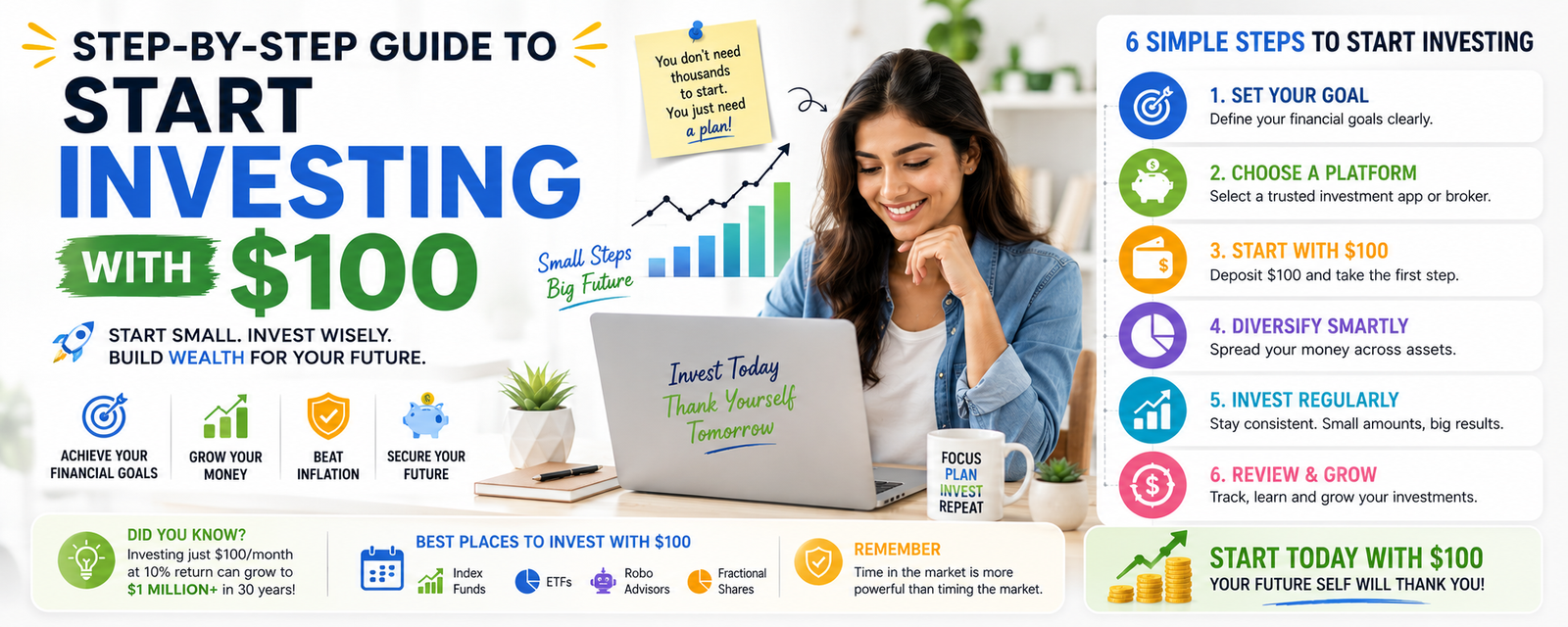
That belief kept me on the sidelines far longer than made sense, and I suspect it’s kept a lot of other people out too. Here’s the actual truth: modern investing tools have made it entirely possible to start with $100, invest it thoughtfully, and build real habits that compound over years. You don’t need a windfall. You need a hundred dollars, a decent platform, and a plan that doesn’t require you to become a financial expert overnight.
Let’s walk through exactly how to do this properly, step by step. One quick note before we start: I’m not a financial advisor, and none of this is personalized financial advice — think of it as a solid, well-informed starting framework you can adapt to your own situation.
Step 1: Get Clear on Why You’re Actually Investing
Before any money moves anywhere, it’s worth sitting with a simple question: why do you actually want to invest? Your answer shapes almost everything that follows, because different goals call for genuinely different approaches.
Common reasons people start investing include saving for retirement, building long-term wealth generally, working toward buying a house, creating a passive income stream, or simply trying to grow their savings faster than inflation quietly erodes them.
If your goal is long-term wealth building specifically, you have real room to invest in assets that grow over time even though they’ll fluctuate along the way — you’re playing a long game, not trying to time next month’s market moves.
Step 2: Build At Least a Small Safety Net First
Before putting money into investments, it’s worth having some emergency savings set aside first. Life has a habit of throwing unexpected expenses at you — medical bills, car repairs, a sudden job loss — and you don’t want to be forced to sell investments at a bad moment just to cover something urgent.
Financial experts generally suggest saving somewhere around 3 to 6 months of living expenses before making larger investments. That said, if you’re working with limited funds right now, you don’t need to wait until that fund is fully built before starting to invest small amounts — you can genuinely do both simultaneously, gradually building your safety net while your first small investments start working in parallel.
Step 3: Pick a Platform You Actually Trust
Once you’re ready to move forward, you’ll need somewhere to actually place your money. Modern investing apps have made this dramatically easier than it used to be, removing a lot of the friction and confusion that once kept beginners away.
A few things worth checking for when comparing platforms: low or zero commission fees (so your returns aren’t quietly eaten by transaction costs), the ability to buy fractional shares, a genuinely beginner-friendly interface, solid educational resources built into the platform, and real security along with proper regulatory protection.
Plenty of platforms today let you start investing with genuinely small amounts of money, which is exactly what makes this whole conversation possible in the first place.
Where to Actually Put Your First $100
Once your account is set up, the real question becomes: where does the money actually go? Here are the beginner-friendly options worth understanding.
1. Index Funds
Index funds are widely considered one of the safest, simplest starting points for a new investor. Rather than betting on a single company, an index fund tracks the performance of a broad group of companies — some track the largest companies in the overall stock market, for instance, giving you exposure to hundreds of businesses through a single investment.
Why they’re popular with beginners: genuine diversification, lower risk than picking individual stocks yourself, low ongoing management fees, and solid long-term growth potential. A number of well-known, highly successful investors have publicly recommended index funds as the best starting point for anyone new to investing. Even with just $100, you can own a small stake in an index fund representing hundreds of underlying companies at once.
2. Exchange-Traded Funds (ETFs)
ETFs work similarly to index funds in that they bundle together a collection of assets, but they trade on stock exchanges the way individual stocks do, giving you a bit more flexibility in how and when you buy and sell.
Common ETF categories include technology-focused funds, healthcare funds, dividend-focused funds, and funds covering global markets broadly. ETFs are popular precisely because they combine real diversification with genuine flexibility — with $100, you can actually spread that money across a few different ETFs and diversify your risk across multiple industries at once.
3. Fractional Stocks
Buying individual company stock used to require a meaningful chunk of money — if a single share cost $500, you needed the full $500 to get in. Fractional shares have changed that considerably, letting you buy a small slice of an expensive stock with whatever amount you actually have.
As an example: instead of needing the full $500 for one share of a pricier company, you could invest just $20 or $50 and own a proportional fraction of that share. This lets beginners build a small portfolio of companies they genuinely believe in, without needing large sums to get started.
4. Dividend Stocks
Dividend stocks are shares of companies that regularly distribute a portion of their profits back to shareholders — these regular payouts are called dividends.
Why people gravitate toward them: they can provide a genuine passive income stream, they tend to offer more long-term stability, and reinvesting the dividends back into more shares can accelerate your portfolio’s growth through compounding. Even a fairly small initial investment can, over time, gradually build into a meaningful passive income stream if you’re consistent about reinvesting.
5. Robo-Advisors
Robo-advisors are automated platforms that build and manage an investment portfolio on your behalf, using algorithms to create a diversified mix of assets based on your specific goals and comfort with risk.
The appeal here is real: they’re genuinely beginner-friendly, they handle portfolio management automatically, they build in diversification without you needing to think through asset allocation yourself, and fees tend to run low. With a robo-advisor, your $100 gets automatically spread across multiple assets according to a strategy suited to you — a genuinely solid option if you want a more hands-off approach to investing from day one.
A Simple Way to Split Your First $100
If you’re staring at your $100 and genuinely unsure how to divide it, here’s a straightforward beginner allocation worth considering as a starting template:
- $40 → Index fund
- $30 → ETF
- $20 → Fractional stock
- $10 → Dividend stock
This kind of spread puts your money across a few different investment types rather than concentrating it in just one, and that diversification is genuinely one of the more reliable ways to reduce risk while still building toward long-term growth.
Making Your $100 Grow Faster Over Time
Starting with $100 is a genuinely solid first step, but consistency — not the size of your first deposit — is really the engine behind long-term wealth. A few strategies worth building into your approach from the start:
Invest on a Regular Schedule
Rather than investing once and stopping, consider putting in small amounts on a regular cadence — something like $25 a week, or $50 a month. This approach is often called dollar-cost averaging, and it works by smoothing out the impact of market volatility, since you’re buying at a mix of prices over time rather than trying to guess the “right” moment to invest a lump sum.
Reinvest What You Earn
When dividends or profits come in, reinvesting them rather than withdrawing tends to accelerate growth considerably through compounding — essentially, you start earning returns on your returns, not just your original investment. Over enough time, this compounding effect can turn genuinely modest, steady investments into a substantial portfolio.
Stay Focused on the Long Haul
The stock market moves up and down constantly, and that volatility is completely normal, not a sign something’s wrong. Successful investors tend to focus on long-term growth rather than reacting to short-term swings — historically, markets have trended upward over long stretches of time, even accounting for the dips along the way. Patience is genuinely one of the more underrated skills in investing.
Mistakes Worth Steering Clear Of
Plenty of beginners stumble into the same handful of missteps early on — understanding them ahead of time can help you avoid unnecessary losses.
Chasing quick riches. A lot of new investors get pulled toward “hot stocks,” hoping for a fast payoff. This approach is genuinely risky and frequently ends in losses rather than gains — steady, long-term growth is a far more reliable strategy.
Investing blind, without research. Always make an effort to actually understand what you’re putting money into — the company, the industry, or the fund itself. A bit of homework upfront meaningfully reduces your risk down the line.
Panic selling when the market dips. Market downturns are a completely normal part of investing, but plenty of beginners panic and sell the moment prices drop. More experienced investors often view these dips as buying opportunities rather than reasons to flee.
Putting everything into one single investment. Diversification matters enormously here — avoid pouring all your money into a single stock or asset, and instead spread it across different sectors and asset types to reduce your overall risk.
Why Compounding Is Genuinely the Most Powerful Tool You Have
One of the most powerful forces in investing is compound growth — essentially, earning returns not just on your original investment, but on the returns that investment has already generated. Over time, this effect can dramatically accelerate how quickly your wealth actually grows.
Here’s a useful illustration: investing $100 a month at an average 8% annual return could theoretically grow to somewhere north of $15,000 after 10 years, north of $36,000 after 20 years, and past $100,000 after 30 years. (Worth noting: this assumes a consistent average return, which real markets don’t guarantee year to year — but it illustrates just how much consistency and time can do together.) This is really the core case for starting now rather than waiting for a “better” moment — time in the market is doing a huge share of the work here.
Investing vs. Saving — They’re Not the Same Job
It’s worth being clear that saving and investing serve genuinely different purposes, and a solid financial foundation usually needs both.
Saving is best suited for your emergency fund, short-term expenses you know are coming, and general financial stability and liquidity.
Investing is better suited for long-term wealth building, retirement planning, and working toward financial independence over a longer time horizon.
Combining both — a solid savings cushion alongside a consistent investing habit — tends to create a genuinely stronger overall financial position than leaning entirely on one or the other.
Final Thoughts
Starting your investing journey doesn’t require a large sum of money sitting around waiting to be deployed. With the tools available today — fractional shares, low-fee platforms, robo-advisors — anyone can genuinely begin building wealth with just $100.
The single most important step is simply getting started. Even a modest first investment can grow meaningfully over time when it’s paired with consistency, patience, and reasonably thoughtful decision-making along the way.
Focus on learning as you go, keep your investments diversified rather than concentrated, and reinvest your profits whenever you can. Given enough time, a portfolio that started at $100 can genuinely grow into something far larger than that initial number suggests.
The goal here was never quick profits — it’s long-term financial growth and stability. And that journey can genuinely start today, with a hundred dollars and a decent plan.
A final note: this article is meant to give you a solid, general starting framework, not personalized financial advice — everyone’s situation is different, and it’s worth talking to a licensed financial advisor before making significant investment decisions.