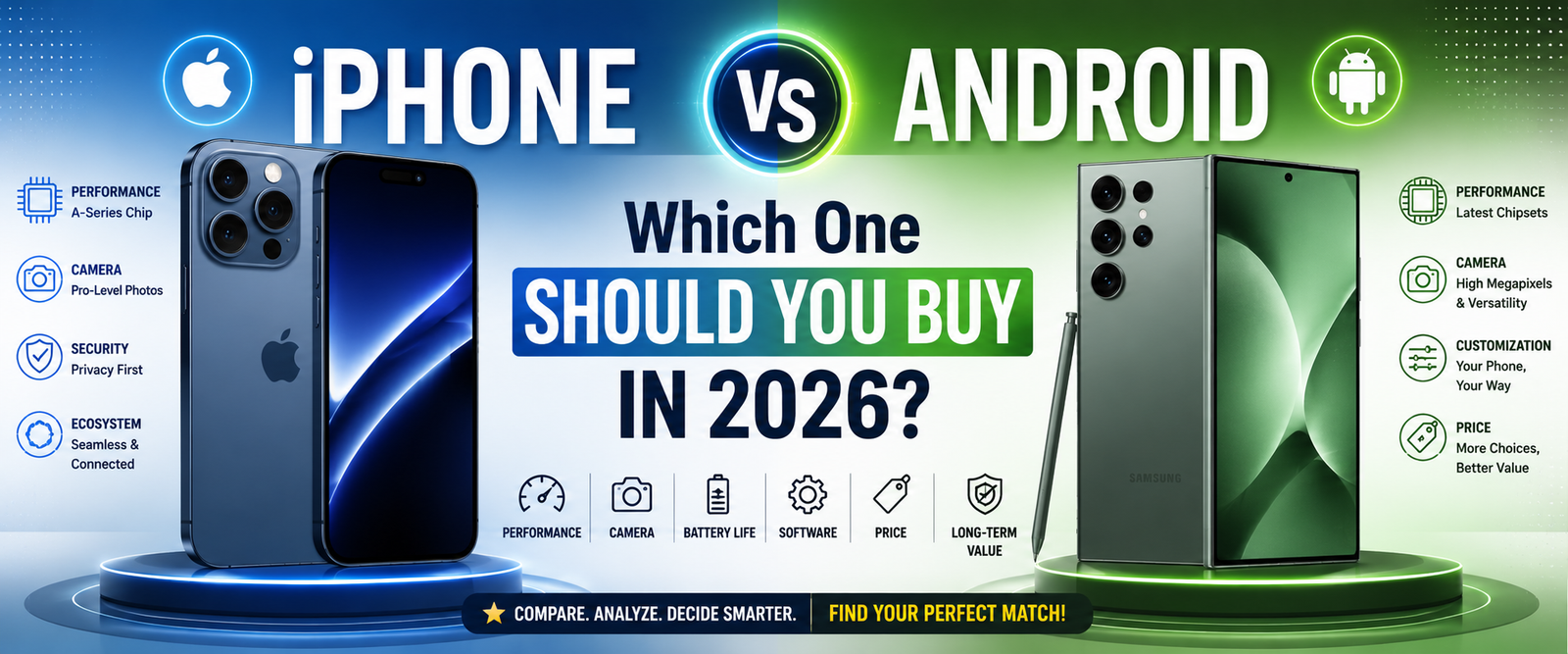
iPhone vs Android in 2026: Which One Should You Actually Buy?
Every family has at least one of these arguments, and mine is no exception. My sister has been Team iPhone since the iPhone 4, and she treats any suggestion of switching as a personal insult. My cousin, meanwhile, has never owned anything but Android and genuinely can’t understand how anyone tolerates a phone they can’t customize down to the last icon. Every holiday dinner, without fail, someone brings up phones, and it turns into the same good-natured debate it’s been for over a decade now.
Here’s the thing, though — in 2026, this debate is more nuanced than it’s ever been. Both platforms have spent years one-upping each other, and the gap that used to clearly separate them has narrowed in some places and widened in others. If you’re standing in a store right now trying to decide, or scrolling through options online at 1 a.m. trying to talk yourself into a decision, I get the paralysis. This isn’t a simple choice anymore, and honestly, it shouldn’t be treated like one.
So let’s actually walk through it — properly, honestly, without pretending one side is obviously correct. By the end of this, you should have a genuinely clear sense of which platform actually fits your life, rather than just picking whichever one your friends use.
A Quick Look at What’s Out There Right Now
Before we get into the actual comparison, it’s worth knowing what the current flagship lineup looks like on both sides, since these are the phones most people are actually choosing between.
On the Apple side, you’ve got the iPhone 17 Pro Max sitting at the top of the lineup as Apple’s premium flagship, alongside the slightly more affordable iPhone 17 Pro, which still delivers high-end performance without quite the same price tag.
On the Android side, the landscape is a lot more varied. The Samsung Galaxy S24 Ultra 5G remains one of the most well-reviewed flagships on the market, known for both its 5G performance and strong overall ratings. The Google Pixel 10 Pro 5G represents Google’s latest push into premium territory, particularly strong on the software and camera side. And the OnePlus 15 5G has built a reputation for delivering flagship-level performance while undercutting the premium competition on price — a phone that consistently gets praised for punching above its price point.
These phones represent where both platforms currently stand — powerful processors, sophisticated cameras, and AI features baked into nearly everything. But the real question isn’t which specific model is “best.” It’s which ecosystem actually fits how you use your phone.
First, What Are We Actually Comparing?
It helps to step back and understand what these two platforms actually are, because the difference goes deeper than just the logo on the back.
iPhone refers to the line of smartphones made by Apple, running on Apple’s own iOS operating system. The key thing that separates Apple from virtually every other phone maker is that Apple controls both the hardware and the software entirely. Nobody else makes an iPhone. That tight control is exactly what gives Apple devices their famously polished, tightly optimized experience — the hardware and software are built together, by the same company, specifically for each other.
Android, on the other hand, is an operating system built by Google, but it’s used across dozens of different manufacturers — Samsung, OnePlus, Xiaomi, and many others. Because so many different companies build Android phones, the platform ends up covering an enormous range of devices, price points, and design philosophies. There’s no single “Android phone” the way there’s a single “iPhone” — there’s an entire universe of them.
That fundamental structural difference is really the root of almost everything else we’re about to talk about.
The Real Differences That Matter in 2026
1. How the Phones Actually Feel to Use
The most immediately obvious difference between the two platforms is the interface — how it feels to actually pick up the phone and use it day to day.
iPhones have built their reputation on simplicity. The interface is clean, consistent, and intuitive, and that consistency holds true whether you’re using the newest model or one from a few years back. This is a big part of why iPhones tend to be such a comfortable choice for people who aren’t especially tech-savvy — there’s very little of a learning curve, and the experience doesn’t vary much from device to device. The animations are smooth, the design language is simple, and everything just feels the same no matter which iPhone you’re holding.
Android takes the opposite philosophy, leaning hard into flexibility and customization. You can install custom launchers, rearrange and resize widgets, change themes entirely, and even swap out your default apps for alternatives you prefer over the built-in options. Experts in the space generally agree that Android’s more open ecosystem gives users a level of flexibility that Apple’s more closed system simply doesn’t allow. If you’re someone who likes tinkering with how your phone looks and behaves, Android gives you a lot more room to play.
2. How Much Choice You Actually Get
Apple releases a relatively small number of iPhone models each year, and that limited lineup comes with real tradeoffs in both directions. On the plus side, you get consistently high build quality, optimized performance, and hardware that behaves predictably across the lineup. On the downside, your choices are genuinely limited — you can’t easily find an iPhone with a dramatically different design or price point outside of what Apple has decided to release that year.
Android goes the other direction entirely, with hundreds of models available across dozens of brands. That variety means a genuinely wide range of prices, an enormous spread of designs and screen sizes, and specialized categories that simply don’t exist on the Apple side — gaming phones built for performance, foldable phones that fundamentally rethink the form factor, and budget phones that make smartphones accessible to people who could never afford a flagship. A phone like the Samsung Galaxy S25 Ultra 5G delivers premium hardware and advanced camera capabilities at the high end, while a mid-range Android device can offer genuinely strong performance for a fraction of the price. That kind of range simply doesn’t exist within Apple’s ecosystem.
3. What You’ll Actually Pay
Price is probably the single biggest practical difference between these two platforms, and it’s worth being honest about it upfront.
iPhones sit firmly in the premium end of the market, generally ranging anywhere from around $700 to $1,600 for new models, with very limited options if you’re working with a tighter budget. The iPhone 17 Pro Max, for instance, is positioned squarely as a premium device — top-tier hardware, advanced camera systems, and a price tag to match.
Android, by contrast, genuinely spans every price category imaginable. There are legitimately usable budget phones under $200, solid mid-range options around the $400 mark, and flagship devices that climb above $1,000 and compete directly with Apple’s top-tier offerings. A phone like the OnePlus 15 5G is a good example of Android’s pricing flexibility in action — it delivers performance that rivals many premium smartphones, but at a noticeably lower price than most of the competition.
If budget is a major factor in your decision — and for most people, it is — Android simply offers more room to find something that fits.
4. How Long Your Phone Will Actually Stay Supported
Software updates matter more than people tend to think about when they’re initially buying a phone, because they directly affect both security and how long your device stays genuinely usable.
Apple has built a strong reputation here. iPhones typically receive updates for many years after release, and those updates tend to roll out consistently across the entire lineup at the same time, arriving fairly quickly once a new version is ready. It’s common for iPhone users to receive meaningful software support for five to six years after purchase — a genuinely long runway compared to a lot of the tech industry.
Android’s update situation is more fragmented, because it depends heavily on which manufacturer made your specific phone. Some brands, notably Samsung and Google, have significantly closed the gap in recent years and now offer considerably longer support windows than they used to. But cheaper Android phones, especially budget models, often still receive fewer updates over a shorter period — something worth checking carefully before you buy, since it varies so much brand to brand.
5. Security and Privacy
Security has long been one of Apple’s strongest selling points, and that reputation is largely earned. Because Apple tightly controls both the App Store and the broader iOS ecosystem, it’s able to closely manage what software actually makes it onto your device, which meaningfully reduces the risk of malware compared to more open systems.
That said, Android has been closing this gap steadily. Recent reporting suggests Android has made real strides in strengthening its defenses, particularly around phishing attempts and common scam tactics that used to be a bigger vulnerability on the platform.
iPhone’s security advantages tend to center on a genuinely strict app review process before anything reaches the App Store, strong built-in privacy controls, and frequent, timely security updates. Android’s security strengths, meanwhile, lean on steadily improving malware protection, security features you can actually customize to your own preferences, and continued improvements to biometric authentication like fingerprint and face unlock. The honest takeaway here is that both platforms are genuinely secure today, especially if you’re using either one responsibly — avoiding sketchy downloads, keeping your software updated, and using strong authentication.
6. What Apps You’ll Actually Have Access To
Both platforms offer millions of apps at this point, so this is less of a dealbreaker than it used to be — but there are still some real differences worth knowing.
Apple’s App Store is known for stricter quality control, which tends to result in apps that feel more polished and optimized specifically for iOS. It’s also common for developers to release new features on iOS first, before bringing them over to Android later.
Google’s Play Store, on the other hand, offers a larger overall variety of apps and generally more open policies for developers to publish their work. The tradeoff is that app quality can vary more from device to device, simply because Android runs on such a wide range of hardware.
7. Camera Quality: It Depends What You’re Shooting
Camera performance has become one of the biggest factors people weigh when choosing a new phone, and this is genuinely one of the closer categories in the whole comparison.
iPhones have built a strong reputation specifically around video recording — consistent photo quality, strong color accuracy, and video capture that’s widely considered some of the best in the smartphone world. It’s part of why so many content creators and vloggers gravitate toward iPhones specifically for filming.
Android phones, meanwhile, tend to push camera hardware innovation faster and more aggressively. You’ll often see higher megapixel sensors, more advanced AI-driven photography features, and specialized hardware like periscope zoom lenses that allow for genuinely impressive optical zoom ranges. The Google Pixel 10 Pro 5G in particular has built its reputation almost entirely around computational photography — using AI-powered image processing to produce photos that punch well above what the raw hardware specs might suggest.
If video is your priority, iPhone tends to have the edge. If you care more about photography innovation and flexibility, Android — particularly Pixel devices — often leads the way.
8. Customization: Android’s Clearest Win
If there’s one category where Android has a decisive, unambiguous advantage, it’s customization.
Android lets you install entirely custom launchers that change how your whole phone looks and feels, swap out default apps for your preferred alternatives, deeply customize themes and visual styling, and take advantage of split-screen multitasking to run two apps side by side. For a lot of Android users, this level of control over their own device is precisely the reason they’ve stuck with the platform for years.
Apple has made real progress here too — widgets and home screen customization have genuinely improved in recent versions of iOS — but even with those additions, the overall experience remains considerably more restricted than what Android offers. If deep customization matters to you, this category alone might settle the decision.
9. How Well Your Devices Talk to Each Other
If you own multiple devices, ecosystem integration becomes a much bigger deal than people initially expect, and this is an area where Apple has traditionally held a clear edge.
Apple’s ecosystem is built to work as a single, cohesive unit — your iPhone, Mac, iPad, Apple Watch, and AirPods are all designed to communicate with each other seamlessly. Features like AirDrop for instant file sharing, Handoff for picking up a task on one device right where you left it on another, and iMessage all make moving between Apple devices feel remarkably frictionless.
Android’s ecosystem integration has improved significantly too, connecting well with Google’s own suite of services, Windows computers, and a growing range of smart home devices. The catch is that the experience can vary noticeably depending on which manufacturer made your specific phone, since it’s not one single company controlling the entire chain the way Apple does.
If you’re already deep into Apple products — a Mac, an Apple Watch, AirPods — sticking with iPhone tends to make everyday life measurably smoother. If you’re more platform-agnostic or already invested in Google’s services, Android integration has gotten genuinely strong too.
10. Artificial Intelligence and Smart Features
AI has become one of the defining battlegrounds for smartphones in 2026, and both platforms are investing heavily here.
Apple has been steadily weaving AI into features like photo editing, smarter voice assistant capabilities, and more intelligent battery optimization that learns your usage patterns over time.
Android has arguably pushed even further into this space, with features like intelligent call screening, AI-powered photo editing tools, and increasingly accurate voice transcription. Google’s own Pixel phones in particular have built a strong reputation specifically around their AI capabilities, often serving as the showcase for features that eventually spread across the wider Android ecosystem.
The Honest Pros and Cons
iPhone
What it does well: smooth, consistent performance across the board, genuinely long software support, strong built-in security, excellent video recording quality, and premium design and build quality.
Where it falls short: it’s expensive, offers limited customization compared to Android, and gives you far fewer device choices to pick from.
Android
What it does well: an enormous range of prices to fit almost any budget, deep customization options, genuinely innovative hardware pushed by intense competition between manufacturers, and a huge variety of phone designs and form factors.
Where it falls short: software updates are inconsistent and depend heavily on which brand you buy, and app optimization can vary noticeably from device to device.
So, Which One Should You Actually Buy?
Honestly, it comes down to what you personally value most in a phone — there’s no universally “correct” answer here.
Lean toward iPhone if you want something simple and easy to use without much of a learning curve, you value long-term software support that keeps your phone secure and current for years, you’re already invested in other Apple devices and want that seamless ecosystem integration, or resale value matters to you — iPhones have historically held their value better than most Android devices.
Lean toward Android if you want the freedom to customize your phone extensively, you want access to the widest possible price range so you can find something that fits your specific budget, you’re drawn to the latest hardware innovations as they emerge, or you simply want more device options to choose from rather than a handful of models released once a year.
The Final Verdict
Both platforms are genuinely excellent choices in 2026, and honestly, that competition between them is exactly what keeps pushing the whole industry forward — better cameras, faster processors, and smarter software on both sides, year after year.
If what you want is something simple, reliable, and tightly integrated with other devices you already own, an iPhone is very likely your best bet. If what you’re after is flexibility, deep customization, and a wider range of hardware to choose from, Android is probably the better fit for how you actually want to use your phone.
At the end of the day, there isn’t a single “best” smartphone platform — there’s only the one that actually fits your needs, your budget, and the way you genuinely live your life. Figure that part out first, and the rest of the decision tends to fall into place on its own.