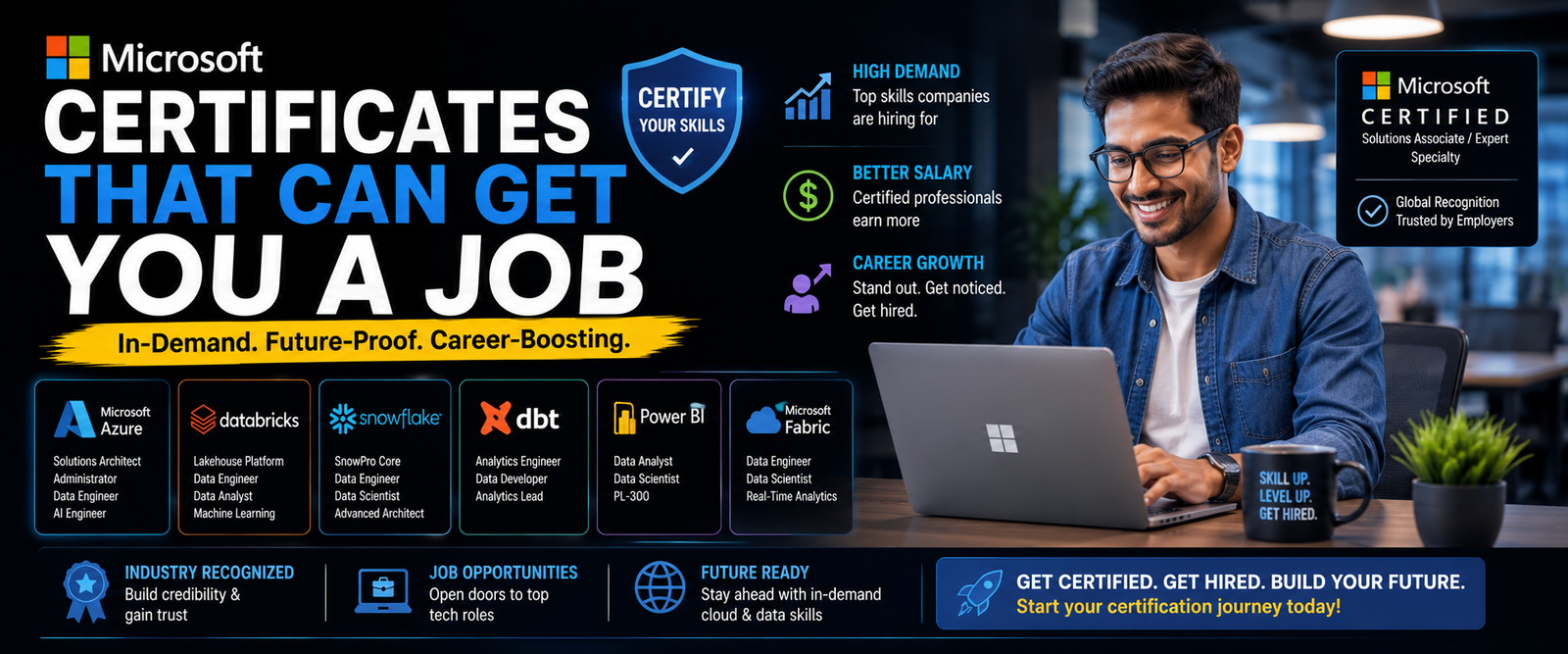
Microsoft Certificates That Can Actually Get You a Job
A guy I used to work with — let’s call him Raj, because that’s his name — spent almost a decade doing IT support, the kind of job where you’re constantly resetting passwords and untangling printer issues, and quietly wondering if there was more waiting for him professionally. On a whim, he spent four months studying for the Azure Administrator certification on evenings and weekends. Six weeks after passing the exam, he had a cloud engineer role that paid nearly 40% more than what he was making before. Nothing else about his situation had changed — same experience, same skills he’d been quietly building for years. What changed was that he now had a credential that let an employer instantly verify what he already knew.
That’s the real value proposition behind professional certifications in tech, and it’s a big part of why they’ve become such a serious part of how people build careers, degree or no degree. Employers are increasingly focused on practical, job-ready skills, and while a college degree still carries weight, certifications have become one of the clearest, fastest ways to prove you can actually do the thing you say you can do. Among all the certification providers out there, Microsoft is one of the most respected names in the industry, and for good reason — its certifications map closely onto real technologies businesses are actively using right now: cloud computing, data analytics, cybersecurity, and software development among them.
If you’re a job seeker or a career changer wondering whether a Microsoft certification is worth your time, let’s walk through exactly which ones open doors, what they actually teach you, and how to figure out which path fits where you want to go.
Why Employers Actually Care About These Credentials
Before getting into the specific certifications themselves, it’s worth understanding why they carry the weight they do.
Microsoft’s reach gives these credentials instant credibility. As one of the largest technology companies on the planet, with its tools embedded across businesses of every size globally, a Microsoft certification isn’t some obscure badge — it’s something hiring managers immediately recognize and trust.
The exams test real skills, not just memorized theory. Microsoft certification exams are built to reflect actual, practical use of the technology, which means passing one genuinely demonstrates hands-on capability rather than just an ability to cram for a test.
They tend to translate into real career movement. Certified professionals frequently qualify for better roles and stronger salaries than their uncertified peers with similar experience — Raj’s story isn’t the exception it might sound like.
They focus on technology that’s actually in demand. These certifications center on the tools businesses are genuinely using day-to-day — cloud infrastructure, data analysis, security, and modern software development — rather than dated or niche skill sets.
They’re structured to let you progress naturally. Microsoft organizes its certifications into clear tiers — Fundamentals, Associate, and Expert — so you can build up your credentials step by step rather than needing to leap straight into advanced material.
Understanding the Three Certification Levels
It helps to know where you’re starting from before picking a path.
Fundamentals certifications are genuinely beginner-friendly, designed for people who are new to a specific technology area or to tech in general. These are a great entry point if you’re switching careers or just starting out.
Associate certifications step things up a level, focusing on practical, job-ready skills that align with entry-level to mid-level professional roles. This is where most people land their first cloud, data, or security job.
Expert certifications represent advanced technical mastery and generally assume real hands-on experience already under your belt — these tend to open doors to senior, higher-paying roles.
Knowing which tier matches your current experience keeps you from either wasting time on something too basic or getting overwhelmed by something too advanced too soon.
1. Microsoft Azure Fundamentals (AZ-900)
This is one of the most popular entry points into the Microsoft certification world, and for good reason — it introduces the basics of cloud computing and the Azure platform without requiring any prior technical background.
What you’ll actually learn: core cloud computing concepts, the fundamental Azure services, how security and compliance work within Azure, and how Azure’s pricing and support models function.
Where it can lead: roles like cloud support specialist, junior cloud engineer, or general IT support positions with a cloud-focused edge.
Cloud computing remains one of the fastest-growing corners of the tech industry, since businesses of every size increasingly depend on cloud platforms to store data, run their applications, and scale operations without maintaining physical servers. For someone brand new to the industry, this certification builds a genuinely solid foundation to grow from.
2. Microsoft Azure Administrator Associate (AZ-104)
This certification is built for people who’ll actually be managing cloud services day-to-day — deploying, monitoring, and maintaining cloud infrastructure rather than just understanding it conceptually.
Skills covered: managing Azure identities and governance, implementing and managing storage solutions, deploying virtual machines, and monitoring cloud resources to keep everything running smoothly.
Where it can lead: Azure Administrator, Cloud Engineer, or Systems Administrator roles.
As more organizations migrate their operations into the cloud, they need people who can actually keep that infrastructure running reliably — this certification positions you as exactly that person.
3. Microsoft Azure Developer Associate (AZ-204)
If your interest leans more toward building software than managing infrastructure, this certification is the natural fit. It focuses specifically on developing applications that run on Azure.
Skills covered: building cloud-based applications, working with APIs and microservices, integrating cloud storage into applications, and monitoring how those applications perform once deployed.
Where it can lead: cloud developer, software engineer, or application developer roles.
Modern software increasingly relies on cloud infrastructure by default, which makes developers who genuinely understand cloud environments considerably more valuable than those who only know traditional, on-premise development.
4. Microsoft Azure Solutions Architect Expert
This is where things step up into genuinely advanced territory. Solutions architects are the people responsible for designing complex, scalable, secure systems that entire organizations depend on.
Skills covered: designing overall cloud architecture, managing identity and security at scale, implementing storage and networking solutions, and optimizing cloud performance across large systems.
Where it can lead: Cloud Solutions Architect, Senior Cloud Engineer, or Infrastructure Architect roles.
This is also one of the higher-paying paths in the entire technology industry, largely because the people holding these roles are responsible for critical systems that businesses genuinely can’t afford to get wrong.
5. Microsoft Data Analyst Associate
Data has become one of the most valuable resources any organization has, and companies increasingly rely on skilled analysts to turn raw numbers into actual strategic decisions. This certification focuses on data analysis using Microsoft’s tools, with Power BI at the center of it.
Skills covered: preparing and transforming raw data, building data visualizations, creating interactive dashboards, and using Power BI for deeper analysis.
Where it can lead: data analyst, business intelligence analyst, or reporting specialist roles.
Strong data analysis skills are in demand across an unusually wide range of industries — finance, healthcare, retail, and marketing all lean heavily on people who can make sense of their data and turn it into decisions.
6. Microsoft Security, Compliance, and Identity Fundamentals
Cybersecurity has climbed to the top of the priority list for most organizations, and this certification introduces the foundational concepts and Microsoft security technologies that underpin that work.
Skills covered: identity management, security compliance frameworks, threat protection basics, and risk management principles.
Where it can lead: security analyst, IT security specialist, or compliance officer roles.
With cyber threats only growing more sophisticated and frequent, professionals with even foundational security knowledge are increasingly sought after across nearly every industry.
7. Microsoft Cybersecurity Architect Expert
This is the advanced counterpart to the fundamentals certification above, focused on designing security solutions across full enterprise environments rather than individual systems.
Skills covered: security architecture design, identity protection strategy, threat detection systems, and cloud security at an enterprise scale.
Where it can lead: cybersecurity architect, security consultant, or enterprise security engineer roles.
Organizations depend heavily on people in these roles to protect the digital infrastructure their entire business runs on — this is genuinely high-stakes, high-responsibility work, and it’s compensated accordingly.
8. Microsoft AI Engineer Associate
Artificial intelligence is reshaping industries at a genuinely rapid pace, and this certification focuses specifically on building AI-powered solutions using Microsoft’s tools, centered around Azure AI.
Skills covered: working with machine learning models, natural language processing, computer vision applications, and integrating AI services into broader systems.
Where it can lead: AI engineer, machine learning engineer, or AI developer roles.
AI specialists currently sit among the highest-paid professionals in the entire technology sector, and that demand shows no signs of slowing as more companies race to integrate AI into their products and operations.
9. Microsoft 365 Certified: Modern Desktop Administrator
A huge number of organizations run their day-to-day operations on Microsoft’s productivity and collaboration tools, and this certification focuses on managing those Windows environments effectively — spanning both Windows itself and Microsoft 365.
Skills covered: managing Windows devices across an organization, deploying operating systems, managing user identities, and configuring security settings appropriately.
Where it can lead: IT support specialist, desktop administrator, or systems administrator roles.
This is a genuinely solid, steady path for anyone drawn to the more infrastructure-and-operations side of IT rather than pure development or data work.
10. Microsoft Dynamics 365 Certifications
These certifications shift focus toward enterprise business applications — think customer relationship management systems and financial management tools that large organizations rely on to actually run their operations.
Skills covered: sales and marketing automation, customer service management systems, business analytics, and financial management platforms.
Where it can lead: business systems consultant, CRM specialist, or ERP consultant roles.
Businesses depend heavily on Dynamics systems to keep their operations organized, which makes professionals fluent in these platforms genuinely valuable, particularly to mid-size and large organizations.
How to Actually Prepare for These Exams
A few things that consistently help people pass, beyond just reading a textbook cover to cover:
Use Microsoft’s own learning paths. Microsoft offers official, structured training modules for most of these certifications, built specifically to align with what’s actually on the exam.
Get real hands-on time with the tools. Reading about Azure and actually clicking around inside it are two very different kinds of learning — the second one sticks.
Take practice exams before the real thing. These are genuinely useful for spotting exactly where your knowledge has gaps, rather than walking into the real exam and discovering them the hard way.
Build actual projects as you go. A real-world project, even a small personal one, does more to reinforce what you’ve learned than passive review ever will — and it doubles as something concrete to show employers later.
Does the Certification Actually Get You Hired?
It’s worth being honest here: a certification alone doesn’t guarantee a job offer. But it meaningfully improves your odds in several specific ways.
It demonstrates verified technical ability. Employers don’t have to just take your word for it — the certification itself is third-party proof.
It makes your resume more visible. Recruiters frequently search specifically for candidates holding particular certifications, which means having one can put you in front of opportunities you’d otherwise never see.
It opens doors to more specialized roles. Certified professionals often qualify for positions that wouldn’t even consider an uncertified applicant with equivalent hands-on experience.
It builds genuine confidence. Working through structured, comprehensive material tends to sharpen your actual technical knowledge, which shows up naturally in interviews even beyond the certificate itself.
What Can You Actually Expect to Earn?
Salaries obviously vary by location, experience, and specific role, but as a general sense of where things land globally: cloud engineers often earn upward of $90,000 a year, data analysts commonly see $70,000 or more, cybersecurity specialists frequently clear $100,000, and cloud architects — reflecting the seniority and responsibility of the role — often earn $120,000 or more.
These figures aren’t outliers. As businesses continue adopting digital infrastructure at a fast clip, demand for people who can actually run, secure, and build on top of it keeps climbing right alongside it.
Picking the Right Certification for You
The best certification is the one that actually matches your genuine interest, not just the one with the highest headline salary.
If cloud technology genuinely excites you, the Azure certifications are your natural starting point. If you find yourself drawn to numbers, patterns, and turning raw data into insight, the Data Analyst certification is worth pursuing. If cybersecurity is where your curiosity lives, focus on the security-track certifications. And if you’d rather be building software than managing systems, the Azure Developer path fits better.
Matching the certification to your actual interests isn’t just about enjoyment — it genuinely increases your odds of sticking with the studying, passing the exam, and thriving once you’re actually in the role.
Final Thoughts
Technology keeps moving, and the professionals who stay ahead of that movement are the ones who keep updating their skills rather than resting on what they learned years ago. Microsoft certifications offer a genuinely structured, well-respected path toward exactly that kind of continuous growth, while giving employers a clear, verifiable signal of what you actually know.
Whether you’re just stepping into the tech industry for the first time or you’re an experienced professional looking for your next move, certifications spanning cloud computing, data analytics, cybersecurity, AI, and enterprise systems can meaningfully shift your career trajectory.
The formula isn’t complicated: pick the certification that genuinely fits where you want to go, put in the real hands-on hours rather than just skimming material, and build actual projects you can point to. In a job market where demonstrable skill increasingly matters more than a resume alone can convey, a Microsoft certification can be exactly the stepping stone that gets your foot in the door — and, like it did for Raj, quietly changes what your career looks like from here.