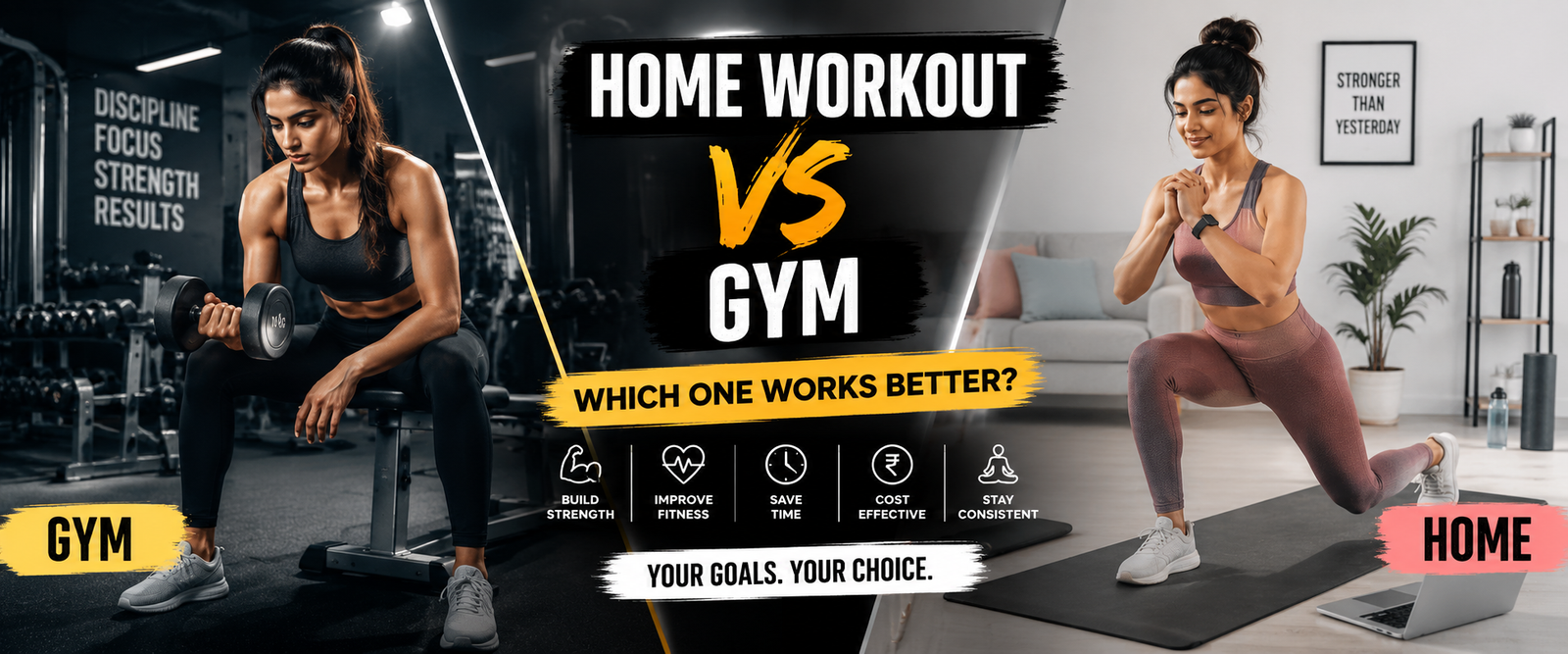
Home Workout vs Gym: Which One Works Better?
I still remember the exact moment I got a gym membership for the first time. I walked in, saw a row of machines that looked like they belonged on a spaceship, watched someone deadlift twice their body weight without breaking a sweat, and quietly decided I would just “look around” for twenty minutes before leaving. That was seven years ago. I’ve since gone through phases of gym obsession, phases of working out on a yoga mat in my living room at 6 a.m. in my pajamas, and everything in between.
So when people ask me, “Should I work out at home or join a gym?” — I get it. It’s one of the first real decisions anyone makes when they start taking their fitness seriously, and it feels like a much bigger decision than it actually is. The truth, after years of doing both, is refreshingly simple: neither one is “better.” They’re just different tools, and the right one depends on your life, not on some universal fitness law.
Let’s actually dig into this properly — the real pros, the real cons, the costs, the myths, and how to figure out which lane fits you right now (because it might change later, and that’s fine too).
Why We’re Even Having This Conversation
Before comparing the two, it’s worth remembering why exercise matters in the first place, because that’s the thing that should actually be driving your decision — not which option looks cooler on Instagram.
Moving your body regularly does a lot of quiet, unglamorous work behind the scenes: it helps regulate your weight, keeps your heart working efficiently, gives you more usable energy throughout the day, takes the edge off stress and anxiety, keeps your muscles and bones strong as you age, and — something people underrate constantly — it genuinely improves how well you sleep.
Health guidelines generally suggest aiming for around 150 minutes of moderate exercise a week. That’s it. That’s roughly 20-25 minutes a day, and there is nothing in that guideline that specifies where you have to do it. A brisk walk up and down your stairwell counts. So does a spin class. So does wrestling with a resistance band in your bedroom while your dog looks at you like you’ve lost your mind.
Keep that in the back of your head as we go: the goal is the movement, not the venue.
What We Actually Mean by “Home Workout”
A home workout is exactly what it sounds like — training in your own space, using whatever combination of bodyweight movements, light equipment, or online guidance you’ve got available. This can look like:
- Bodyweight circuits (push-ups, squats, lunges, planks)
- Yoga or Pilates sessions
- Cardio intervals in your living room
- Resistance band training
- A pair of adjustable dumbbells and a YouTube video
A huge number of people now build entire routines around apps, streaming platforms, or free YouTube channels, and honestly, the quality of free home-workout content available today is something my younger self would not have believed. The pandemic accelerated this shift dramatically — people who once considered a gym membership non-negotiable suddenly discovered they could get a genuinely tough workout in their spare bedroom.
What We Actually Mean by “Gym Workout”
A gym workout means training at a dedicated facility that’s been built specifically for exercise — treadmills, weight machines, free weights, cable stations, rowing machines, stationary bikes, the works. Beyond the equipment, most gyms also offer things you simply can’t replicate at home without hiring people: personal trainers, group fitness classes, and staff who can correct your form before you hurt yourself.
For a lot of people, the gym isn’t really about the equipment at all — it’s about the structure. Walking into a building that exists solely for exercise puts you in a different headspace than trying to convince yourself to do burpees three feet from your couch.
The Case for Home Workouts
1. Convenience You Can’t Buy
This is the big one. No commute, no waiting for a machine, no packing a gym bag the night before. You roll out of bed, throw on whatever you slept in, and you’re training. For anyone juggling a job, kids, or an unpredictable schedule, this alone can be the difference between working out consistently and not working out at all.
2. It’s Genuinely Cheaper
Gym memberships add up faster than people expect once you factor in monthly fees, gas or transit costs, and the occasional locker or class add-on. Home workouts, by contrast, can be almost free. A yoga mat and a resistance band will run you less than a single month’s gym fee in most cities, and plenty of effective routines need zero equipment at all.
3. No Audience, No Pressure
A lot of beginners quietly dread the idea of being watched while they figure out how a machine works. At home, there’s no one clocking your form, your outfit, or how much weight is on the bar. That privacy lets a lot of people actually experiment, mess up, and improve without the self-consciousness that keeps them from trying new things in public.
4. Total Schedule Flexibility
Early bird? Night owl? Someone who only has a free 15-minute window between meetings? Home workouts bend to fit your day instead of the other way around.
5. Nobody’s Hogging the Squat Rack
At home, the only thing standing between you and your workout is you. No waiting in line for a machine, no awkward “how many more sets do you have” conversations.
Where Home Workouts Fall Short
It wouldn’t be a fair comparison if I only listed the good stuff, so here’s where training at home tends to break down.
Equipment ceiling. You can go a long way with bodyweight training and a couple of dumbbells, but eventually most people hit a wall. If your goal is serious strength gains, there’s only so much you can do without a barbell, a squat rack, or a leg press.
No one’s watching your form. This sounds minor until you’re six weeks into doing squats slightly wrong and your knees start complaining. A trainer or even a gym-savvy friend catching a bad habit early can save you months of frustration — or an actual injury.
Motivation is a solo sport. When your workout partner is a laptop screen, it’s very easy to “just skip today” in a way that’s much harder to do when you’ve already driven somewhere and paid for the privilege of being there.
Space is finite. Not everyone has a spare room to swing kettlebells in. Small apartments can genuinely limit what kinds of movements are practical.
The Case for the Gym
1. Equipment That Actually Changes What’s Possible
Leg press machines, cable stations, squat racks, Smith machines — this is gear that’s simply not going to fit (or be affordable) in a home setup. If you’re chasing serious strength or muscle-building goals, this equipment opens doors that bodyweight training can’t.
2. Actual Expert Eyes on You
A good personal trainer will build you a plan, correct your form in real time, and keep you accountable to your own progress in a way that’s very hard to replicate solo. This guidance is genuinely valuable, especially in the first few months when bad habits are easiest to form and hardest to unlearn later.
3. Borrowed Motivation
There’s something to be said for being surrounded by other people mid-workout. You don’t need to talk to anyone — just being in a room where everyone’s clearly working hard has a way of nudging your own effort up a notch.
4. Built-In Variety
Strength machines, cardio equipment, functional training zones, group classes — a decent gym gives you enough variety that boredom becomes a choice rather than an inevitability.
5. A Dedicated Headspace
Walking into a gym mentally flips a switch for a lot of people. It’s a space built for one purpose, and that focus can be harder to summon in a living room that’s also where you watch TV, eat dinner, and scroll your phone.
Where the Gym Falls Short
It costs real money. Between memberships, potential trainer sessions, class fees, and parking, gym costs can climb quickly — and unlike a yoga mat, that’s a recurring expense, not a one-time purchase.
Travel eats into consistency. Even a short commute adds friction. On a busy week, that 15-minute drive is sometimes the exact reason a workout gets skipped entirely.
Peak-hour chaos. Evenings after work, weekend mornings — gyms get crowded, machines get occupied, and your 45-minute plan can quietly turn into 70 minutes of waiting around.
Intimidation is real. Plenty of beginners feel out of place next to people who clearly know exactly what they’re doing. That discomfort can quietly chip away at motivation before a routine even gets going.
Let’s Talk Money
If cost is the deciding factor for you (and for a lot of people, it genuinely is), here’s the blunt version:
Home workouts can cost you almost nothing beyond a mat, maybe a resistance band or a pair of dumbbells, and possibly a modest subscription to an app or streaming service. Most of these are one-time purchases, not recurring bills.
Gym memberships, on the other hand, are an ongoing cost — monthly fees, plus whatever you add on top for trainers, classes, or travel. Over a year, this adds up to significantly more than the average home setup, even at a mid-range gym.
Neither is “wrong.” Some people happily pay gym fees because the structure and equipment are worth it to them. Others would rather put that money elsewhere and get creative at home. It’s a budgeting decision as much as a fitness one.
So Which One Gets Better Results?
Here’s the myth that needs to die: the gym does not automatically produce better results than home training. Results come down to intensity, consistency, nutrition, and recovery — not the zip code where you happen to be sweating.
Someone doing focused, consistent bodyweight workouts five days a week at home will very often outperform someone who has a gym membership they use twice a month out of guilt. Location isn’t the variable that matters most. Showing up repeatedly is.
That said, there are ceilings. If you’re chasing elite-level strength numbers, at some point you’ll likely need the loading capacity that only a gym provides. But for general fitness, fat loss, muscle tone, and long-term health? Both paths get you there.
Solid Exercises for Each Setting
At home, you can build a genuinely effective routine around:
- Push-ups
- Squats
- Lunges
- Planks
- Jumping jacks
- Burpees
These use nothing but your own body weight and can build real strength while torching calories, especially when done in circuits with minimal rest.
At the gym, the heavy hitters tend to be:
- Bench press
- Deadlifts
- Barbell squats
- Cable rows
- Lat pulldowns
These allow for progressive overload with actual external weight, which is where a lot of serious strength gains ultimately come from.
Who Tends to Thrive at Home
Home training tends to suit people who:
- Have unpredictable or packed schedules
- Value privacy while they’re learning
- Want to keep costs minimal
- Are just getting started and feeling their way in
- Like the freedom of an adaptable routine
It’s an especially good entry point for total beginners. A lot of people start at home, build confidence and a baseline level of fitness, and later transition into a gym once they know what they actually want out of it.
Who Tends to Thrive at the Gym
The gym tends to suit people who:
- Want access to heavier or more specialized equipment
- Do better with external structure
- Want professional coaching
- Enjoy the energy of group classes
- Are chasing specific strength or bodybuilding goals
Serious lifters and competitive athletes especially benefit from what a gym offers, simply because the equipment ceiling matters more at that level.
Why Not Both?
Plenty of people land on a hybrid approach rather than picking a side, and honestly, this is often the smartest move. A common split looks like: strength training at the gym a few days a week, paired with home sessions for cardio, mobility work, or yoga on the days in between. You get the equipment and structure when you want it, and the convenience and flexibility when you need it.
Staying Consistent, Wherever You Train
Regardless of which side of this debate you land on, consistency is the actual engine behind results. A few things that genuinely help:
- Set a clear goal. Weight loss, muscle gain, better endurance — name it specifically so you can measure progress against something real.
- Put workouts on the calendar. Treat them like appointments, not vague intentions.
- Track your progress. Even a simple notes app log keeps you honest and motivated when progress feels slow.
- Pick things you actually enjoy. The “best” workout is the one you’ll still be doing in six months.
- Be patient with yourself. Real change takes longer than social media makes it look.
A Few Myths Worth Retiring
“Gyms are always better.” Not true — consistency beats location almost every time.
“You need equipment to build muscle.” Bodyweight training, done properly and progressively, builds real strength.
“More exercise equals faster results.” Overtraining is a real thing, and it tends to backfire through injury and burnout rather than accelerating progress.
So, Which One Actually Wins?
Honestly? There isn’t a single right answer here, and anyone who tells you there is hasn’t actually tried both seriously. The right choice depends on your goals, your budget, your schedule, your personality, and what genuinely keeps you motivated to show up.
If you’re just starting out, home workouts are often the easier, lower-pressure entry point. As your goals get more specific — more strength, more structure, more coaching — a gym might start to make a lot more sense. And if you can swing it, a mix of both gives you the best of everything.
What actually matters, more than anything else in this entire comparison, is not where you train. It’s whether you keep training at all.
Final Thoughts
Whether your workout happens on a gym floor or a living room rug, the real win is the habit itself. Exercise is one of the few things that pays off in almost every part of your life — your body, your mood, your sleep, your long-term health — and none of that cares which building you were standing in when you did the work.
Pick the option that you’ll actually stick with. Stay consistent. Eat reasonably well. Be patient with the process. And remember that your fitness journey doesn’t have to look like anyone else’s — it just has to keep moving forward.