The Skills That Actually Pay in 2026: A Practical Guide to Earning Online
Somewhere in the last few years, the old script quietly stopped making sense to a lot of people. Go to school, get a degree, land a stable 9-to-5, retire in forty years — that path still exists, but it’s no longer the only sane one, or even the most reliable one. Meanwhile, a parallel economy has grown up around the internet, one where a college dropout who’s good at running Facebook ads can out-earn someone with an MBA, and a twenty-two-year-old editing videos from her bedroom can make more than her parents did at the same age.
None of this is hype. It’s just what happens when the tools of production — a website, a laptop, an internet connection — become available to almost anyone, and the tools of distribution — freelance platforms, social media, search engines — become available right alongside them. The barrier to earning online was never really about talent. It was about access. That barrier is mostly gone now.
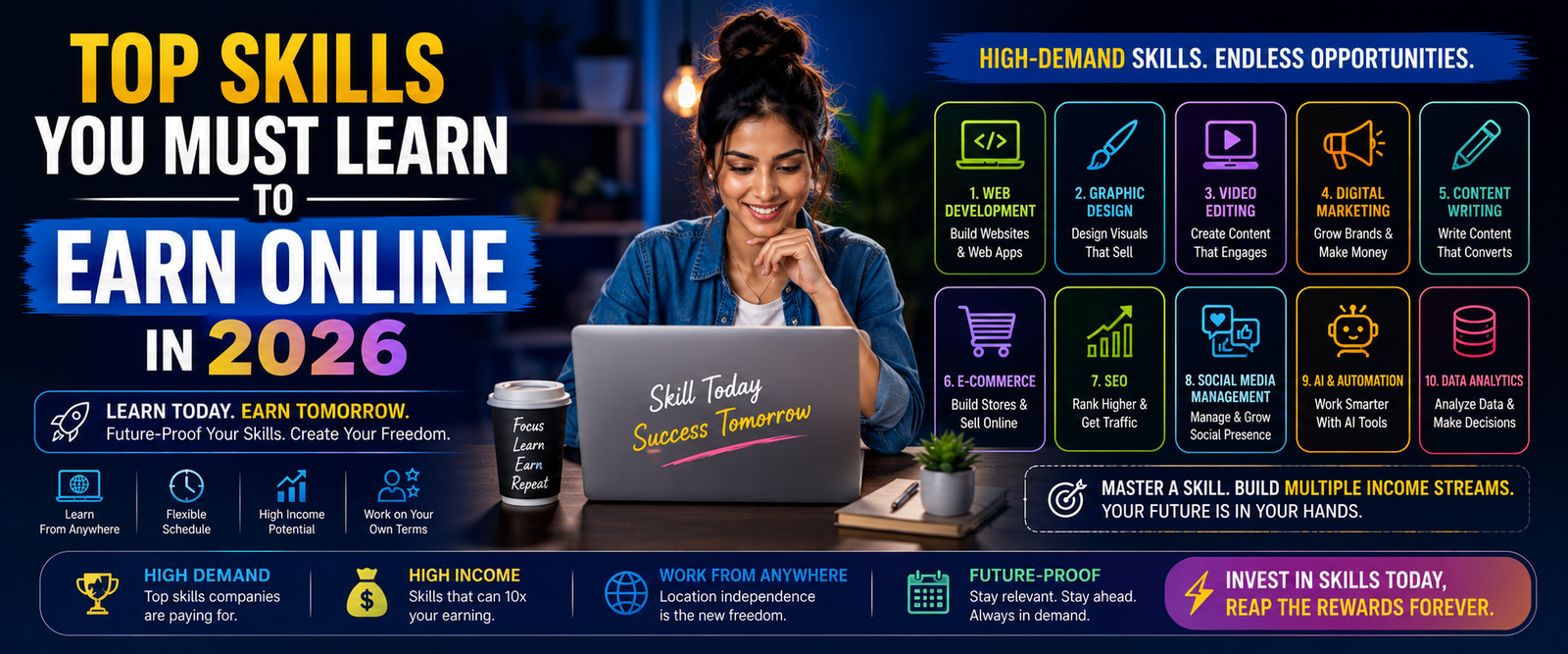
What’s left is a much simpler, if less comfortable, truth: the people who earn well online in 2026 are the ones who picked a genuinely valuable skill and actually learned it, deeply enough to be trusted with real money and real problems. This guide walks through what those skills currently are, why each one matters, how people are actually using them to earn, and — just as importantly — how to figure out which one is worth your time, instead of chasing all ten at once and mastering none of them.
Why This Moment Is Different
It’s worth pausing on why 2026 specifically feels like an inflection point, rather than just more of the same drift that’s been happening since freelancing sites first appeared.
Remote work stopped being an experiment. What began as a pandemic-era necessity has settled into a permanent, normalized way of working for a huge slice of the professional world. Companies that spent years insisting “this only works in person” have quietly built entire departments that have never met in a room together. That shift didn’t just make remote jobs more available — it made location genuinely irrelevant to a growing list of roles, which means your competition (and your opportunity) is now global, not local.
Digital businesses aren’t the exception anymore — they’re the default. A new business today is far more likely to start as a website, an app, or a storefront on someone else’s platform than as a physical shop with a lease. Every one of those businesses needs the same underlying scaffolding: something built, something marketed, something analyzed, something protected. That scaffolding is where the actual jobs live.
Freelancing went from side hustle to legitimate career path. Platforms that once felt like a place to pick up scraps of work have matured into functioning marketplaces where skilled people run six-figure freelance practices, often with more autonomy and better margins than a traditional job would offer.
AI rewired what “valuable skill” even means. This is the biggest and most disorienting shift. Some tasks that used to require years of training can now be meaningfully assisted, or even substantially automated, by AI tools. That’s genuinely unsettling if your skill was narrow and mechanical. But it’s also created an entirely new category of high-value work: knowing how to actually direct these tools, integrate them into real workflows, and get reliable output out of them. The people who learn to work with AI are, so far, doing considerably better than the people ignoring it or the people naively assuming it replaces the need to learn anything at all.
Put those four forces together, and you get a labor market where the specific skills below aren’t just “nice to have” — they’re close to the new baseline for anyone who wants real optionality in how and where they work.
1. Artificial Intelligence and AI Tools
It’s hard to overstate how quickly AI moved from “interesting experiment” to “quiet infrastructure running underneath half the businesses you interact with.” Customer service chatbots, marketing copy drafts, automated data summaries, product recommendation engines — a huge amount of this now has some AI system doing real work behind the scenes, and somebody had to set that up.
That “somebody” is increasingly not a PhD in machine learning. It’s a person who understands, at a practical level, how to get useful, reliable output from these tools and how to wire that output into an actual business process.
What’s actually worth learning here:
- Working fluently with AI content and creative tools, well past the surface-level “type a prompt and hope” stage
- Building automations that connect AI tools to the rest of a business’s software stack, so output doesn’t just sit in a chat window
- Prompt engineering — which sounds like a buzzword until you’ve watched two people get wildly different quality out of the same tool because one of them actually knows how to ask
- The basics of how machine learning systems work, even without going deep into the math, so you can reason about what these tools are and aren’t good at
- Practical AI integration into existing business workflows — sales, support, content, operations
How people are turning this into income:
- AI consulting for small and mid-sized businesses that know they should “do something with AI” but have no idea what
- Building and selling automation services — the unglamorous but extremely valuable work of connecting AI tools to spreadsheets, CRMs, and internal processes
- Producing content at a volume and speed that would have been impossible solo a few years ago, using AI as a genuine force multiplier rather than a replacement for judgment
- Building small AI-powered apps or tools that solve one specific, narrow problem well
The professionals doing best here aren’t the ones who can recite how a transformer model works. They’re the ones who show up to a business, understand its actual bottlenecks, and know exactly which AI tool — and which prompt, and which integration — solves it. That’s a translation skill as much as a technical one, and it’s remarkably teachable.
2. Digital Marketing
Every business that exists online, which by now is nearly every business, needs someone who can get in front of the right people and convince them to act. That has not changed, and there’s no realistic version of the next decade where it stops mattering — if anything, as more competitors crowd into every digital space, the skill of standing out gets more valuable, not less.
The core disciplines worth knowing:
- Search engine optimization — getting found by people who are actively looking
- Social media marketing — building attention and trust on the platforms where your audience already spends time
- Email marketing — arguably still the highest-return channel per hour invested, and one that never fully goes out of style
- Paid advertising across the major platforms, understood well enough to actually generate a positive return, not just spend a budget
- Content marketing — the slower, compounding cousin of paid ads
Ways this turns into real income:
- Freelance marketing work for businesses that can’t justify a full internal hire
- Running a small agency once you’ve got a few solid case studies behind you
- Affiliate marketing, where you’re paid for the results your marketing generates rather than the hours you put in
- Managing ongoing campaigns for clients who need consistent, competent execution more than flashy one-off ideas
What makes digital marketing durable as a skill, even as tools and platforms shift underneath it, is that the underlying job never changes: understand a specific audience, say something true and compelling to them, and get it in front of their eyes at the right moment. The platforms come and go. That core competency doesn’t.
3. Web Development
Websites aren’t going anywhere, and neither is the need for people who can build them well. Every business that wants to exist online — which is to say, essentially every business — needs a site that actually works, loads fast, and doesn’t look like it was built in an afternoon by someone’s cousin.
Foundational skills:
- HTML and CSS, still the actual bones of the web after all these years
- JavaScript, for anything that needs to feel alive and interactive rather than static
- Responsive design, so a site works whether someone’s on a laptop or a phone
- Front-end frameworks, which speed up building anything beyond the simplest site
- Performance optimization, because a slow site quietly loses customers before they ever see what it’s selling
How to earn with it:
- Freelance website builds, which remain one of the most reliably in-demand freelance categories in existence
- Building sites specifically for local businesses, a market that’s perpetually underserved and often easier to break into than the crowded global freelance platforms
- Building fuller web applications for clients with more complex needs than a simple brochure site
- Launching your own SaaS product, which turns development skill into a scalable business rather than a service you trade hours for
Web development has one big advantage over some flashier skills on this list: it’s concrete. A client can look at a finished site and immediately judge whether it’s good. That clarity makes it a relatively fast skill to prove, even for beginners with a thin portfolio.
4. Data Analytics
Every business now sits on a mountain of data it barely understands — sales numbers, website traffic, customer behavior, marketing performance — and most of them have no one on staff who can turn that pile of numbers into an actual decision. That gap is where data analysts get paid.
Skills that matter:
- Excel, which remains astonishingly relevant despite being decades old, because it’s the tool nearly every business already uses
- SQL, for anyone who needs to pull information directly out of a real database rather than a tidy spreadsheet someone else prepared
- Python, for analysis that goes beyond what a spreadsheet can comfortably handle
- Data visualization, because a brilliant insight buried in a table of numbers convinces no one — a clear chart convinces a room
- Statistical fundamentals, so you’re drawing real conclusions instead of confusing correlation with something meaningful
Ways to earn:
- Working as a data analyst, either in-house or remote, for a company that needs someone to make sense of its numbers
- Consulting, dropping in to solve a specific analytical problem without becoming a permanent hire
- Marketing analytics specifically, which is its own thriving sub-niche given how much money businesses pour into ad spend they can’t fully explain
- Business intelligence reporting, building the recurring dashboards that let leadership make decisions without waiting on a one-off request
What makes this skill quietly powerful is that it’s rarely flashy, but it’s almost universally needed. Nearly every department in nearly every company eventually needs someone who can answer “what does this data actually mean, and what should we do about it?”
5. Content Creation
Somewhere along the way, “making content” stopped being a hobby and became a legitimate career path, and it’s easy to forget how genuinely strange that would have sounded not that long ago. YouTube, blogs, podcasts, newsletters, and social platforms have collectively created an entire economy built on people showing up consistently and saying something worth paying attention to.
Formats worth developing:
- YouTube videos, still one of the most durable and monetizable content formats around
- Blogging, which has quietly remained valuable even as social platforms have exploded, particularly for search-driven, evergreen topics
- Podcasting, which builds an unusually intimate relationship with an audience
- Social content generally — short-form video, posts, threads — as a discovery engine for everything else you make
- Newsletters, which have seen a genuine resurgence as people get tired of algorithm-dependent platforms and want something that lands directly in front of their audience
How creators actually earn:
- Advertising revenue, the most obvious but often least reliable early-stage income source
- Sponsorships, which typically become available once you’ve built even a modest, engaged audience
- Affiliate marketing, recommending products or services you genuinely believe in and earning a cut of resulting sales
- Selling your own digital products — this is where content creation and course creation start to overlap in a genuinely powerful way, since an audience built through content is also, quietly, a built-in customer base
The creators who make this sustainable long-term are rarely the ones chasing viral moments. They’re the ones who show up consistently, in a specific lane, for long enough that an audience starts to trust them — and trust, eventually, is what gets monetized.
6. Graphic Design
Every piece of marketing, every social post, every website, every product package needs a visual identity, and someone has to actually make it. Good design isn’t decoration — it’s often the entire first impression a business gets to make, and businesses know it, which is why design work stays reliably in demand.
Core skills:
- Photoshop, for image editing and manipulation that goes beyond what simpler tools can handle
- Illustrator, for vector-based work — logos, icons, scalable brand assets
- Canva and similar accessible tools, which have genuinely lowered the barrier to entry for solid design work without a steep software learning curve
- Typography and color theory, the underlying principles that separate design that merely looks fine from design that actually communicates
- Branding, understanding how to build a consistent visual identity across everything a business touches
Ways this becomes income:
- Freelance design work across an enormous range of client needs
- Logo and brand identity packages, often one of the higher-margin services a designer can offer
- Social media graphics, an ongoing, recurring need for nearly every business with an online presence
- Website visuals, working alongside or in support of developers
Design work rewards a strong portfolio more than almost any other skill on this list — clients are judging your visual work visually, immediately, before they ever read a word about your process. That makes an early investment in a genuinely strong portfolio disproportionately valuable.
7. Copywriting
Copywriting is, at its core, the skill of getting someone to actually do something with words — click, buy, subscribe, reply. It’s less visible than design and less technical than development, which is exactly why it’s underrated, and exactly why good copywriters can charge surprisingly high rates: their work has a direct, measurable line to a business’s revenue.
Where copywriting shows up:
- Sales pages, where a course, product, or service actually gets its “yes” or “no” moment from a stranger
- Email copy, the words that turn a list of subscribers into actual customers
- Advertising copy, the small amount of text that has to stop someone mid-scroll
- Website copy generally, which shapes how a visitor understands what a business even does
- Product descriptions, particularly for e-commerce, where the right words measurably move conversion rates
How to earn from it:
- Freelance copywriting, working directly with individual clients
- Ongoing work with marketing agencies who need reliable writing talent without hiring in-house
- Writing specifically for e-commerce businesses, a huge and often underserved niche
- Contributing to full marketing campaigns as the writing arm of a larger creative team
What makes copywriting unusually lucrative for a “just words” skill is accountability — a good copywriter’s work can often be directly tied to a measurable increase in sales, which means clients are willing to pay premium rates for someone who’s proven they can move that number.
8. Video Editing
Video has become the default language of the internet, and every video — every YouTube upload, every ad, every social clip — needs someone shaping raw footage into something people actually want to watch. That someone is increasingly not the person who shot the footage; it’s a specialist brought in specifically for the edit.
Skills worth building:
- The fundamentals of cutting and pacing, which matter more than any fancy effect
- Color correction, which quietly makes footage look professional rather than amateur
- Motion graphics, for the titles, transitions, and visual polish that separate a rough cut from a finished piece
- Sound design, criminally underrated by beginners and immediately noticeable to viewers when it’s done well
- Storytelling through editing — structuring footage so it actually holds attention and builds toward something
Tools worth learning:
- Premiere Pro, still an industry standard
- Final Cut Pro, particularly common in certain creative circles
- DaVinci Resolve, powerful and increasingly popular, with a genuinely usable free tier
- CapCut, which has become a serious tool in its own right for fast-turnaround social content
Ways to earn:
- Editing for YouTube creators who’d rather focus on filming than spend hours in post-production
- Social media video editing, a fast-growing niche given how much short-form content businesses now need
- Promotional and marketing video work for businesses
- General freelance editing services, often built around a specific niche or client type
Editing is one of the more forgiving skills to break into because the learning curve rewards practice almost linearly — the tenth video you edit will visibly, measurably look better than your first, which makes it easy to build a portfolio while you’re still learning.
9. E-commerce and Online Selling
Online shopping isn’t a trend anymore, it’s just how a huge portion of retail happens, and that shift has created an entire category of people who make a living building and running online stores, whether their own or someone else’s.
Skills to develop:
- Product research, understanding what will actually sell before you invest in it
- Setting up and running an actual online store, from the technical build to the day-to-day operation
- Dropshipping, a lower-capital way to test product ideas without holding inventory yourself
- Product marketing specifically for e-commerce, which has its own particular playbook
- Customer service, which quietly determines whether a store gets repeat business or a wave of refund requests
Platforms worth knowing:
- Shopify, the dominant platform for independent online stores
- Amazon, an enormous marketplace with its own distinct set of rules and opportunities
- Etsy, particularly strong for handmade, niche, or creative products
- WooCommerce, for anyone who wants a store built on their own WordPress site rather than a third-party platform
Ways to earn:
- Running your own store from product sourcing through to customer service
- Selling digital products, which sidesteps inventory and shipping entirely
- Dropshipping physical products with lower upfront risk
- Print-on-demand businesses, which combine design skill with e-commerce infrastructure in a genuinely accessible way for beginners
E-commerce rewards people who treat it as an actual business rather than a get-rich-quick scheme — the ones who do well tend to obsess over their specific product and customer, not just the mechanics of the platform they’re selling on.
10. Cybersecurity
As more of the world’s actual money, infrastructure, and sensitive information moves online, protecting all of it has become one of the more urgent, and better-compensated, categories of digital work. Businesses of every size are targets now, not just large corporations, and most of them are underprepared.
Skills worth building:
- Network security fundamentals
- Ethical hacking, learning to find vulnerabilities before someone with worse intentions does
- Risk management, understanding not just technical threats but how to prioritize and communicate them to a business
- Security monitoring, the ongoing work of watching for and responding to threats in real time
- Vulnerability assessment, systematically identifying weak points before they’re exploited
Ways to earn:
- Working as a security analyst, in-house or remote
- Cybersecurity consulting for businesses that need expertise without a full-time hire
- Security auditing services, a periodic, project-based engagement many businesses need regularly
Cybersecurity has a steeper technical learning curve than most skills on this list, but it also comes with a corresponding scarcity premium — genuinely competent security professionals are hard to find, and businesses know exactly how expensive a breach is, which makes them willing to pay well for people who can prevent one.
So Which One Should You Actually Pick?
Ten legitimate paths is a genuinely useless number of options if you try to walk down all of them simultaneously. The honest answer to “which skill should I learn” is: the one where your actual interest, real market demand, and realistic income potential overlap — and where you’re willing to put in months, not days, of consistent practice.
Start with genuine interest, not just perceived opportunity. Every skill above requires real hours of unglamorous practice before it becomes profitable. If you don’t have some baseline curiosity about the subject, that practice becomes a grind you’ll eventually abandon, usually right around the point where it would’ve started paying off.
Actually check whether businesses are hiring for it. It’s worth spending an afternoon looking at freelance platforms and job boards for the specific skill you’re considering, not to copy anyone, but to get a real sense of what’s currently in demand versus what merely sounds impressive in theory.
Weigh income potential honestly, not aspirationally. Some skills have a higher ceiling than others, and some pay well faster than others. Cybersecurity and AI consulting, for instance, often command premium rates quickly because scarcity is high; content creation often takes longer to become reliably profitable because it depends on building an audience first. Neither is wrong — just be honest with yourself about which tradeoff you’re actually signing up for.
Bias toward what stays relevant. Trends shift, but certain categories — solving real business problems with data, words, code, design, or security — tend to remain valuable even as the specific tools around them evolve. Chasing whatever’s hottest this month is a weaker long-term bet than building depth in something with staying power.
How Long Does This Actually Take?
There’s no universal timeline here, because it depends heavily on how much time you can realistically put in and how complex the specific skill is. That said, a genuinely honest, commonly observed pattern: consistent practice of one to three hours a day tends to get most people to a job-ready, client-ready level somewhere between three and twelve months.
The variance mostly comes down to complexity — a solid working level of copywriting or basic graphic design tends to arrive faster than a genuinely competent level of cybersecurity or data science, which involve steeper technical foundations. Either way, the operative variable is consistency, not raw talent. Someone practicing an hour a day for a year will, in nearly every case, outperform someone who binges intensely for two weeks and then disappears.
What Separates People Who Actually Earn From People Who Just “Learned a Skill”
Here’s an uncomfortable truth: a huge number of people genuinely learn one of these skills to a reasonably competent level and never earn a meaningful dollar from it. The gap between “I know how to do this” and “people pay me to do this” isn’t usually more skill — it’s a handful of unglamorous habits that most tutorials skip over.
Build actual projects, not just exercises. Course exercises and tutorials teach concepts, but clients don’t hire concepts — they hire proof. A real project, even a small self-initiated one, does more to convince someone to pay you than any certificate.
Put together a portfolio before you feel ready. Nearly everyone feels their early work isn’t good enough to show anyone. Show it anyway. A portfolio with three modest, real projects beats an empty portfolio waiting for a masterpiece that never arrives.
Get onto freelance platforms early, even for small jobs. The first few gigs on any freelance platform are rarely the best-paying ones, and that’s fine — they exist to get you reviews, experience with real client communication, and the confidence that comes from proving you can actually deliver.
Actually talk to other people doing this work. Communities, forums, and industry groups aren’t just for moral support — they’re where you learn which tools are worth your time, which clients to avoid, and which opportunities are opening up before they become common knowledge.
Keep learning after you’re “done.” Nearly every skill on this list sits on top of technology that keeps shifting. The people who stay valuable for years, not just months, are the ones who treat “finished learning” as a myth and keep updating their skill set as tools and platforms evolve.
Bringing It All Together
The digital economy in 2026 offers more genuine paths to a flexible, well-paying career than at almost any point before it — but “more paths available” isn’t the same as “success is automatic.” The skills covered here — AI tools, digital marketing, web development, data analytics, content creation, graphic design, copywriting, video editing, e-commerce, and cybersecurity — are all real, all in demand, and all learnable without a traditional degree standing in the way.
What actually determines whether any of this turns into income isn’t which skill you pick off this list. It’s whether you pick one, commit to it past the point where it feels awkward and unfamiliar, build real proof of your ability, and put yourself in front of the people who’ll actually pay for it.
The internet has already done the hard part — it’s connected you to a genuinely global market of people who need exactly what you could learn to offer. The remaining work, the part nobody can do for you, is showing up consistently enough to become good at it, and then loud enough, in the right places, that the people who need you can actually find you.
Pick one skill. Start today. Let the practice, not the perfect plan, do the rest of the work.